Overview
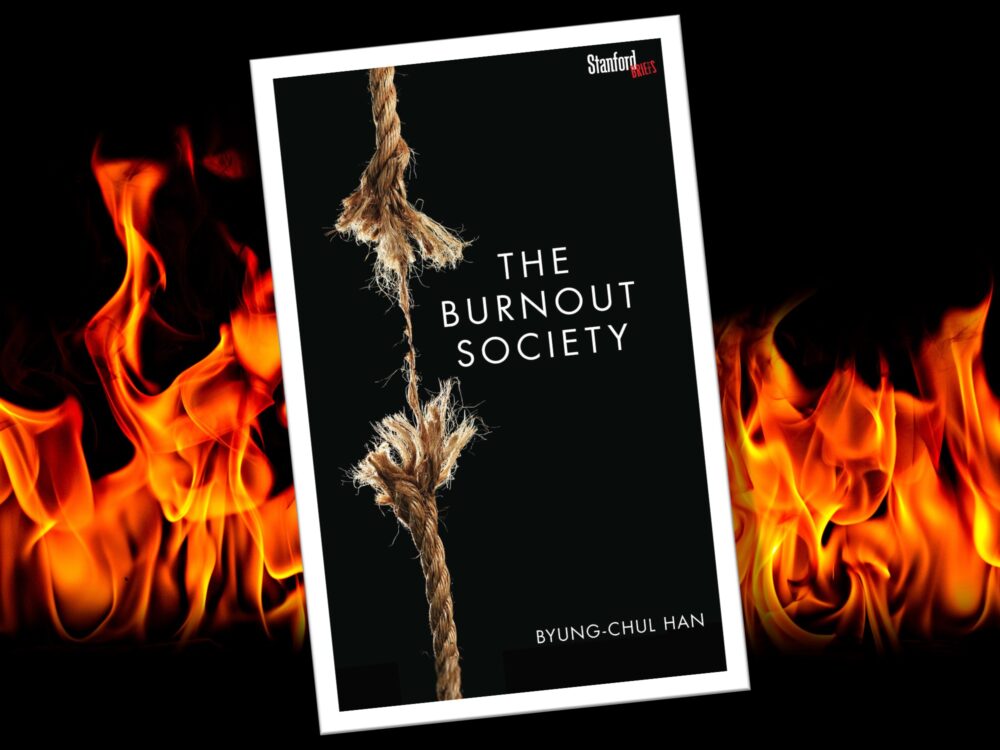
The Burnout Society is a slim but potent philosophical essay by Byung-Chul Han, clocking in at just 60 pages. Despite its brevity, it delivers a sharp critique of contemporary life, particularly the psychological toll of neoliberalism, hyper-productivity, and the cult of positivity. Han argues that today’s society no longer represses individuals through external authority, but rather exhausts them through internalised pressure to perform, achieve, and optimise.
Written in a clear, aphoristic style, the book blends philosophy, sociology, and cultural theory with references to thinkers like Heidegger, Foucault, and Arendt. Han’s central thesis is that modern individuals are burning out not because they are oppressed, but because they are over-engaged. They are constantly pushed to be their own taskmasters. It’s a short read, but one that lingers long after you’ve closed the cover.
Synopsis
The book consists of 60 pages and is divided into eight compact chapters, each tackling a facet of modern psychological and social exhaustion.
- Neuronal Power
Han introduces the idea that today’s power structures operate not through prohibition but through stimulation. Instead of being told “no”, we are constantly encouraged to say “yes” to more work, more productivity, more self-optimisation. This leads to internalised pressure and mental overload, resulting in disorders like burnout and depression. - Beyond Disciplinary Society
Drawing on Foucault, Han argues that we’ve moved beyond the disciplinary society of surveillance and control. Instead, we now live in an achievement society, where individuals willingly exploit themselves. The result is a paradox: freedom becomes a new form of coercion. - Profound Boredom
Han explores Heidegger’s concept of boredom, distinguishing between superficial boredom and “profound boredom”, which allows space for reflection and creativity. In today’s overstimulated world, this deeper boredom is vanishing, replaced by constant distraction and shallow engagement. - Vita Activa
Referencing Hannah Arendt, Han critiques the modern obsession with activity. He suggests that the relentless pursuit of action and multitasking undermines contemplation and genuine thought. The active life, once noble, has become compulsive and hollow. - The Pedagogy of Seeing
This chapter calls for a return to slow, attentive perception. Han laments the loss of contemplative seeing in favour of rapid consumption of images and information. He argues that true understanding requires patience and depth, not speed. - The Bartleby Case
Han uses Melville’s character Bartleby, who famously “prefers not to”, as a symbol of passive resistance. Bartleby’s refusal to participate in the achievement society becomes a quiet form of protest against the tyranny of productivity. - The Society of Tiredness
Here, Han describes a society plagued not by violence but by fatigue. People are worn out by their own ambitions, suffering from what he calls “neuronal illnesses”. The chapter paints a bleak picture of a culture that confuses exhaustion with success. - Burnout Society
The final chapter ties the threads together, portraying burnout as the emblematic condition of our time. Han warns that without a shift in values towards slowness, reflection, and limits, we risk losing our humanity to the machinery of self-exploitation.
Why you should read it?
For the general reader, The Burnout Society offers a refreshing and thought-provoking lens on everyday stress and fatigue. It’s not a self-help book, but it might help you understand why you feel constantly overwhelmed. Han’s writing is accessible, and his insights are surprisingly relatable even if you’ve never opened a philosophy book before.
For specialists in philosophy, sociology, or cultural studies, Han’s work provides a compact but rich critique of neoliberalism and late-modern subjectivity. His synthesis of Heidegger, Foucault, and Arendt is elegant, and his concept of “neuronal power” opens new avenues for understanding contemporary mental health and social dynamics.
Critics and review
The book has been widely discussed in academic and cultural circles. Critics praise Han’s ability to distil complex ideas into digestible prose, though some argue that his aphoristic style can feel too sweeping or lacking in empirical support. Nonetheless, his diagnosis of modern malaise has struck a chord with many readers.
On Goodreads, The Burnout Society holds a solid rating of 3.87 based on over 25,000 reviews. Amazon reviews are similarly positive, with readers appreciating its brevity and depth. Some readers find it too abstract or repetitive, but most agree it’s a timely and important reflection on the pressures of modern life.
Verdict
The Burnout Society is a short but sharp philosophical essay that manages to be both profound and practical. It’s ideal for anyone feeling the weight of modern expectations and looking for a deeper understanding of why we’re all so tired. Han’s critique is not just relevant. It’s urgent.
About the author
Byung-Chul Han is a South Korean-born German philosopher and cultural theorist. He studied metallurgy in Korea before moving to Germany in the 1980s, where he pursued philosophy, German literature, and Catholic theology. He earned his doctorate with a dissertation on Heidegger and later taught at universities in Basel, Karlsruhe, and Berlin. He currently teaches philosophy and cultural studies at the Universität der Künste Berlin.
Han has published over 60 books, many of which explore themes of transparency, digital culture, and emotional life under capitalism. His works include The Transparency Society, Psychopolitics, and The Expulsion of the Other. While admired for his clarity and originality, he has also faced criticism for his sweeping generalisations and lack of empirical grounding. Still, his voice remains one of the most distinctive in contemporary European thought.