

Overview
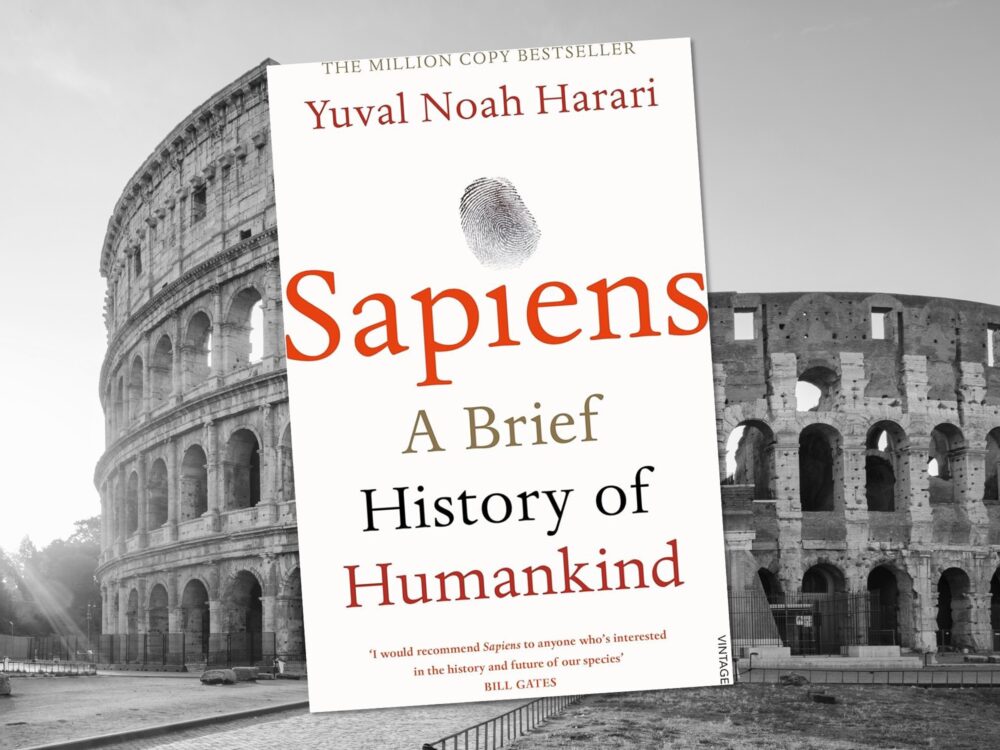
Yuval Noah Harari’s Sapiens is a sweeping narrative of human history, tracing our journey from insignificant apes to the species that reshaped the planet. Harari blends anthropology, biology, economics, and philosophy into a single, highly readable story that explains not only how we got here, but why we behave the way we do. The book is ambitious, provocative, and often surprisingly funny for a work that covers 70,000 years of history.
At the same time, Sapiens is not afraid to challenge cherished myths. Harari questions the stories societies tell themselves about religion, money, nations, and progress. He also invites readers to look at humanity with fresh eyes. The tone is accessible, the arguments bold, and the scope enormous. Whether you agree with all of it or not, the book certainly keeps your brain awake.
Synopsis
The book spans roughly 500 pages and is divided into 20 chapters across four major parts, each exploring a key revolution in human development.
Part One – The Cognitive Revolution
1. An Animal of No Significance
Harari begins by reminding us that Homo sapiens started as a rather unremarkable primate among many others. He describes our early physical limitations and the competitive landscape of the prehistoric world, setting the stage for the surprising rise of our species.
2. The Tree of Knowledge
This chapter introduces the Cognitive Revolution, the moment when humans developed complex language and the ability to imagine things that do not physically exist. Harari argues that shared myths—gods, nations, corporations—became the glue that allowed large groups to cooperate.
3. A Day in the Life of Adam and Eve
Here Harari reconstructs the daily life of hunter‑gatherers, challenging romanticised views of the past. He suggests that foraging societies were often healthier and more egalitarian than later agricultural ones, though not without their own hardships.
4. The Flood
The chapter explores the extinction of megafauna and the spread of humans across continents. Harari presents the controversial idea that early humans played a major role in wiping out large animals, long before modern industry existed.
Part Two – The Agricultural Revolution
5. History’s Biggest Fraud
Harari provocatively calls farming a “fraud”, arguing that agriculture trapped humans in harder labour, worse diets, and crowded settlements. Wheat, he claims, domesticated us rather than the other way around.
6. Building Pyramids
This chapter examines how large-scale cooperation became possible through shared stories and hierarchies. Harari explains how imagined orders, as religion, kingship or bureaucracy enabled societies to organise massive projects.
7. Memory Overload
As societies grew, human memory could no longer manage the complexity. Harari describes how writing emerged as a tool for administration, taxation, and control, rather than for poetry or storytelling.
8. There Is No Justice in History
Harari discusses the origins of social hierarchies, including class, race, and gender. He argues that many inequalities are historical accidents that became entrenched through cultural norms rather than biological necessity.
Part Three – The Unification of Humankind
9. The Arrow of History
This chapter explores how cultures gradually converged through trade, migration, and shared ideas. Harari argues that history tends towards unification, even if the process is messy.
10. The Scent of Money
Harari explains how money became the most universal and efficient system of trust. He traces its evolution from shells to coins to modern finance, showing how it binds strangers together.
11. Imperial Visions
Empires, Harari argues, have been one of the most powerful forces shaping human culture. He examines how empires spread languages, laws, and technologies. They are often violently, but with lasting global impact.
12. The Law of Religion
This chapter looks at religion as a system of moral order. Harari distinguishes between polytheism, monotheism, and humanist religions, showing how belief systems helped societies organise themselves.
13. The Secret of Success
Harari identifies the ability to adapt and absorb ideas from others as the key to human success. Cultures that borrowed freely tended to flourish, while rigid ones stagnated.
Part Four – The Scientific Revolution
14. The Discovery of Ignorance
Harari argues that modern science began when humans admitted they did not know everything. This shift from certainty to curiosity sparked rapid innovation and exploration.
15. The Marriage of Science and Empire
Science and imperialism, Harari suggests, grew hand in hand. Empires funded scientific research, and scientific advances strengthened imperial power, creating a feedback loop.
16. The Capitalist Creed
This chapter explores capitalism as a belief system built on trust in future growth. Harari explains how credit, investment, and consumerism reshaped societies and economies.
17. The Wheels of Industry
Harari describes the Industrial Revolution and its profound impact on work, family life, and the environment. Machines transformed not only production but also human expectations.
18. A Permanent Revolution
Modernity, Harari argues, is defined by constant change. He examines how technology, politics, and culture now evolve at unprecedented speed, leaving societies in a state of continuous adaptation.
19. And They Lived Happily Ever After
This chapter questions whether humans are actually happier today. Harari looks at psychological research and suggests that material progress does not automatically lead to emotional well‑being.
20. The End of Homo Sapiens
Harari concludes with a look at biotechnology and artificial intelligence, raising the possibility that humans may soon engineer their own successors. It is both fascinating and unsettling.
Why you should read it
Sapiens is worth reading because it offers a clear, engaging, and often surprising explanation of how humanity became what it is today. For the general reader, it provides a grand tour of history without requiring any prior scientific knowledge. Harari’s storytelling is lively, his examples memorable, and his humour disarming. Even complex ideas feel accessible, making it an excellent introduction to big‑picture thinking.
For specialists as historians, economists, scientists, or policy experts the book offers a stimulating cross‑disciplinary perspective. You may not agree with all of Harari’s interpretations, but the book encourages debate and invites readers to question assumptions. It is a rare popular work that sparks conversations in both academic circles and everyday life.
Critics and review
Sapiens received widespread acclaim for its ambition, clarity, and narrative power. Many reviewers praised Harari’s ability to synthesise vast amounts of research into a coherent and entertaining story. The book became an international bestseller, translated into dozens of languages, and frequently recommended by public figures, educators, and book clubs. Its bold claims and provocative tone also made it a favourite for public debate.
However, the book also attracted criticism from some scholars who argued that Harari occasionally oversimplifies or stretches evidence to fit his narrative. Despite these debates, the book remains highly rated by readers. On Amazon, it typically scores around 4.5 out of 5 stars, while on Goodreads it holds an average rating of about 4.4 out of 5.
Verdict
Sapiens is an engaging, ambitious, and thought‑provoking journey through human history. It is not a textbook, nor does it pretend to be; instead, it offers a bold narrative that encourages readers to think differently about the world. Whether you admire Harari’s sweeping arguments or challenge them, the book leaves a lasting impression and is well worth the time.
About the author
Yuval Noah Harari is an Israeli historian and professor at the Hebrew University of Jerusalem. His academic work focuses on world history, macro‑historical processes, and the relationship between biology and culture. Harari is known for his ability to connect scientific research with philosophical questions, making complex ideas accessible to a wide audience.
He is also the author of Homo Deus, which explores the future of humanity, 21 Lessons for the 21st Century or Nexus (see my reviews by following the links). Harari has become a prominent public intellectual, speaking on technology, ethics, and the future of society. Some critics have questioned the scientific precision of his claims or his close ties to tech industry figures, but his influence on public debate remains significant.


Leave a Reply