

Overview
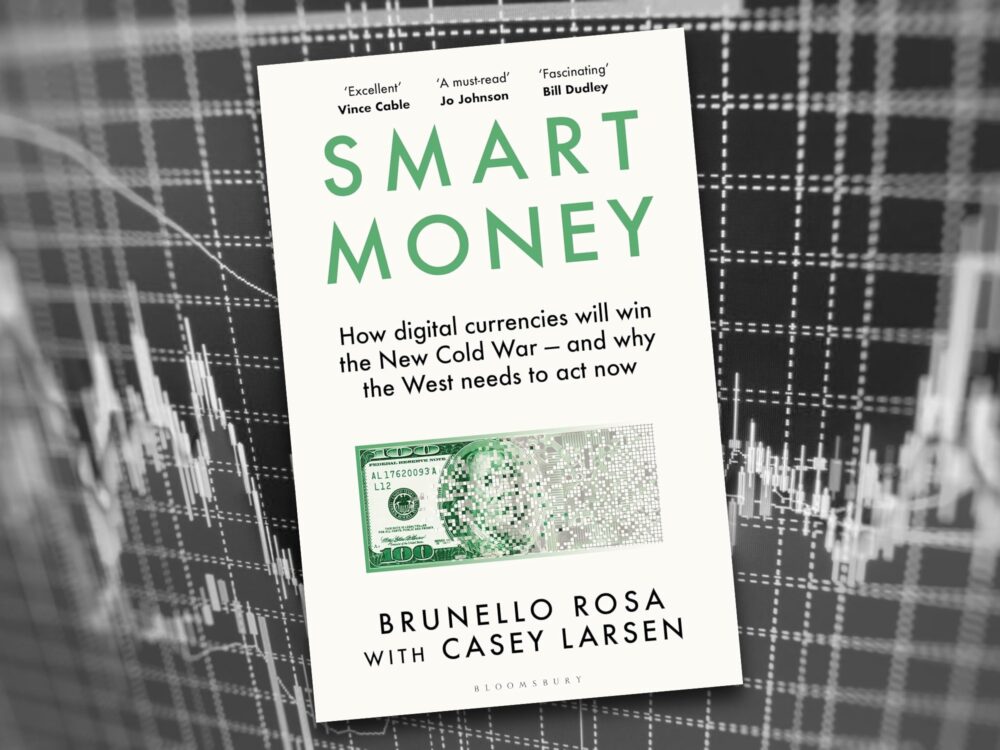
Brunello Rosa’s Smart Money is a timely and ambitious exploration of how digital currencies, especially Central Bank Digital Currencies (CBDCs) are reshaping global power dynamics. The book argues that we are already in a new kind of Cold War, one fought not with missiles but with financial infrastructure, data, and technological supremacy. Rosa explains how the dominance of the US dollar is being challenged and why digital currencies may become the decisive tool in the geopolitical contest between China and the West.
Across its pages, the book blends economics, geopolitics, and technology into a narrative that is both accessible and thought‑provoking. Rosa’s central claim is bold: whoever controls the future of digital money will control the future global order. Whether or not one fully agrees, the book certainly succeeds in making the reader think twice before dismissing CBDCs as a mere technical curiosity.
Synopsis
The book spans 352 pages and is organised into a series of chapters that guide the reader from the basics of digital currencies to their geopolitical implications.
Chapter 1 – The New Cold War
Rosa introduces the idea that the world has entered a new Cold War, this time centred on financial and technological dominance rather than nuclear threats. He outlines how economic tools have become the new weapons of influence.
Chapter 2 – The Rise of Digital Currencies
This chapter explains what digital currencies are, how they work, and why more than a hundred countries are developing CBDCs. Rosa highlights the transformative potential of these technologies for everyday transactions and global finance.
Chapter 3 – China’s Digital Yuan
Rosa examines China’s pioneering role in launching the digital yuan. He argues that Western media have focused too much on surveillance concerns and too little on China’s strategic use of digital money to “de‑dollarise” the developing world.
Chapter 4 – The US Dollar Under Pressure
Here, Rosa discusses the historical dominance of the US dollar and the growing challenges it faces. He explains how digital currencies could accelerate a shift in global financial power.
Chapter 5 – Geopolitics of Money
This chapter explores how digital currencies intersect with international alliances, sanctions, and global trade. Rosa uses the example of Russia’s ability to bypass sanctions after the launch of the digital yuan.
Chapter 6 – The West’s Dilemma
Rosa argues that Western democracies must urgently develop their own digital currencies to remain competitive. He warns that failing to do so could leave them technologically and geopolitically disadvantaged.
Chapter 7 – The Future of Global Finance
The final chapter looks ahead, predicting how CBDCs may reshape economies, societies, and international relations. Rosa concludes with a call for coordinated Western action to ensure that digital money reflects democratic values.
Why you should read it
For the general public, Smart Money offers a clear and engaging introduction to a topic that will affect everyone’s financial life, whether they realise it or not. Rosa explains complex concepts in a way that is accessible without being simplistic, making the book a useful guide for anyone curious about the future of money. Even readers with only moderate financial knowledge will find it eye‑opening.
For specialists such as economists, policymakers, financial analysts, and tech professionals, the book provides a structured and well‑argued overview of the geopolitical implications of CBDCs. Rosa’s policy background and strategic insight make the book particularly valuable for those working in international finance or digital innovation. It is not a technical manual, but it offers a strong conceptual framework that professionals will appreciate.
Critics and review
Smart Money has been well received by reviewers, earning praise and being listed as a Financial Times Economics Book of the Year. Early reviews highlight its clarity, relevance, and strong geopolitical analysis. On Amazon, the book enjoys positive ratings, with readers praising its accessible style and timely subject matter. On Goodreads, it is similarly well regarded, though readers note that it is more analytical than narrative in tone.
Critics generally agree that the book is niche, aimed primarily at professionals and readers with a solid understanding of economics or geopolitics. However, many also point out that it remains approachable for the informed general public.
Some reviewers note that Rosa’s perspective on China is perhaps more optimistic than current geopolitical realities justify especially regarding the digital yuan’s global appeal. This does not undermine the book’s value, but it does invite readers to maintain a critical eye.
Verdict
Smart Money is a sharp, timely, and engaging exploration of how digital currencies may reshape global power. It is not a light read, but it is a rewarding one. It is clear enough for curious non‑experts and rich enough for professionals. While Rosa’s enthusiasm for China’s digital strategy may feel slightly over‑rosy, the book succeeds brilliantly in making a complex topic both understandable and urgent.
About the authors
Brunello Rosa is a financial economist and geopolitical strategist with extensive experience in policy analysis and macro‑financial research. He has worked in both the private and public sectors, advising institutions on global economic trends, monetary policy, and geopolitical risk. His work often focuses on the intersection of finance, technology, and international relations, making him well placed to write about CBDCs and global power shifts.
Beyond Smart Money, Rosa has contributed to numerous policy papers, economic commentaries, and strategic analyses. He is known for his clear communication style and his ability to connect economic developments with broader geopolitical narratives. There is no major public controversy surrounding him, though as an economist who makes bold predictions, his views occasionally spark debate, particularly regarding China’s role in the future financial system.
Leave a Reply