
Overview
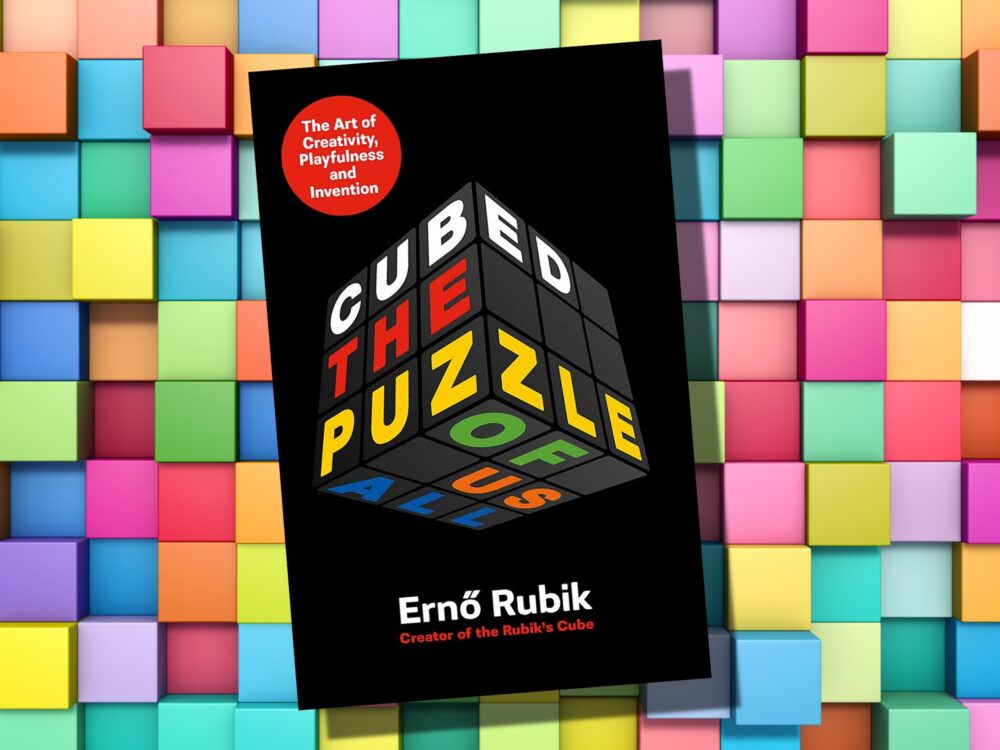
Cubed: The Puzzle of Us All is a reflective and deeply personal memoir by Ernő Rubik, the famously private Hungarian architect who invented the world’s most popular puzzle. Rather than offering a standard, linear autobiography, Rubik uses the book to explore the nature of human curiosity, design, and the unexpected ways a simple plastic object can take on a life of its own. It explores how a three-dimensional teaching tool, originally built in a small Budapest flat behind the Iron Curtain, transformed into a global phenomenon that completely changed pop culture and mathematics.
At its heart, the book is less about the technicalities of the cube and more about the philosophy of play and problem-solving. Rubik examines how our brains handle challenges and why millions of people are drawn to a puzzle with quintillions of combinations. He shares his thoughts on creativity, the joy of remaining a lifelong amateur, and the strange experience of watching his own creation become far more famous than its creator.
Synopsis
The edition of this book consists of 208 pages spread across an introduction, 12 distinct chapters uniquely titled from ONE to TWELVE, and a closing dialogue.
Introduction and chapter ONE
In these chapters, Rubik sets a deeply reflective scene by taking the reader back to his childhood in post-war Budapest. He describes his early obsessions with geometric patterns, drawing, and physical puzzles, detailing how his strict education and training in interior design shaped his worldview. The core message here is that puzzles are not just idle distractions, but vital “creativity machines” that mirror the human need to explore and overcome limitations.
Chapters TWO and THREE
These chapters document the painstaking physical birth of the prototype in 1974. Rubik explains the immense structural challenge of creating an object whose pieces could move independently on three axes without the whole thing falling apart. The breakthrough moment arrives when he realises that the internal mechanism must hold itself together by its own shape rather than relying on external screws, followed by the chilling realization that, once scrambled, he had accidentally built a three-dimensional labyrinth he did not know how to solve.
Chapters FOUR and FIVE
Here, the narrative shifts from design theory to the gritty realities of commerce behind the Iron Curtain. Rubik vividly describes the agonizingly slow and bureaucratic process of getting the “Bűvös Kocka” (Magic Cube) manufactured in communist Hungary, dealing with state-owned factories that lacked motivation or resources. The main takeaway from this section is a fascinating lesson in resilience: despite overwhelming institutional apathy, the sheer, infectious enthusiasm of everyday people who saw the object eventually forced the gears of international trade to turn, leading to its breakthrough at the 1980 Nuremberg Toy Fair.
Chapters SIX and SEVEN
These chapters dive headfirst into the madness of the 1980s global “cube craze.” Rubik tracks how the toy suddenly escaped the control of his creator to become a pop-culture juggernaut, appearing on television, in art galleries, and on the front pages of newspapers. He handles this by analyzing the psychological hold the toy had on society, concluding that the cube became a universal language because it offered a clear, undeniable truth—either it is solved, or it isn’t—in a world full of confusing, ambiguous realities.
Chapters EIGHT and NINE
Here, the author shifts gears to explore the unexpected scientific and social legacy of his invention. He unpacks the mathematics behind the cube, explaining how it served as a perfect physical model for group theory and computer science algorithms, before turning his attention to “speedcubing.” Here, his main message is one of genuine admiration for the younger generations who turned a solitary, private challenge into a highly collaborative, lightning-fast competitive sport, proving that human capability expands when people share knowledge openly.
Chapters TEN, ELEVEN, and TWELVE
These chapters slow the pace right down to ponder wide-ranging philosophical questions about architecture, space, and human nature. Rubik uses these final chapters to argue that our brains are hardwired to find order in chaos, and that the ultimate joy of life lies not in reaching the final destination or the perfect solution, but in the creative struggle of the journey itself. Finally, the book concludes with the “Interview with the authors”, which is a delightfully witty, imaginary double interview between Rubik and the cube. In this playful dialogue, the cube cheekily asserts its status as an immortal design icon that has eclipsed its creator, forcing Rubik to laughingly accept his fate as the mere caretaker of a global phenomenon.
Why you should read it?
For the general public, Cubed offers an engaging peek into the mind of an accidental genius. It is highly relatable because Rubik does not write like an unapproachable scholar; instead, he writes with genuine humility and a real passion for the simple things in life, like messy rooms and gardening. The book encourages readers to look at everyday problems from a fresh perspective, turning the scary concept of “failure” into a harmless game of trial and error. It is a comforting read for anyone who wants to rediscover their own childhood sense of wonder and play.
For a specialized public, such as mathematicians, product designers, and engineers, the book provides useful insights into structural form and the creative process. Rubik’s breakdown of spatial geometry and how he balanced aesthetics with functional mechanics is quite fascinating. Experts will enjoy his deep dives into how a physical object can perfectly model complex mathematical theories, and how the cube became an unintended bridge between human intuition and computer science.
Critics and review
The reception of Cubed was generally positive, with reviewers praising its poetic, philosophical style and Rubik’s genuine modesty. Critics appreciated that the book avoids the usual self-congratulatory tone found in celebrity memoirs, focusing instead on the philosophy of design. However, the book did receive some critical pushback for its loose structure. Some readers complained that Rubik frequently repeats his ideas and wanders off on long philosophical tangents, which can test the patience of those looking for a fast-paced, straightforward business or historical biography.
On major book platforms, the response reflects this split between readers who loved the philosophy and those who wanted more gossip or technical details. On Goodreads, the book holds a respectable average rating of around 3.7 out of 5 stars, where reviewers often comment on its short, easy-to-read nature but note the repetitive phrasing. On Amazon, it enjoys a higher rating of roughly 4.5 out of 5 stars, where purchasers frequently highlight it as an inspiring gift for puzzle enthusiasts and a nostalgic trip down memory lane.
Verdict
Cubed is a charming, if slightly repetitive, look inside the mind of a man who accidentally conquered the toy world. While it occasionally spins its wheels in abstract philosophy when a bit more historical detail would have been welcome, it succeeds as an honest celebration of human curiosity. It is well worth a read, even if you have never managed to solve the cube yourself. Just do not expect it to hand you a cheat sheet for the algorithms.
About the authors
Ernő Rubik is a Hungarian inventor, architect, and professor of design, best known for his background in interior architecture and geometry. His primary field of activity has always been teaching, and he spent decades encouraging students to explore three-dimensional forms at the Hungarian College of Applied Arts. Beyond his teaching and the creation of his famous cube, Rubik has engineered several other mechanical puzzles, such as Rubik’s Magic and Rubik’s Snake, and has authored academic publications including the Rubik’s Cubic Compendium. He has also been a strong advocate for science education, helping found organisations like the Hungarian Engineering Academy and supporting tech institutes to foster young talent.