
Overview
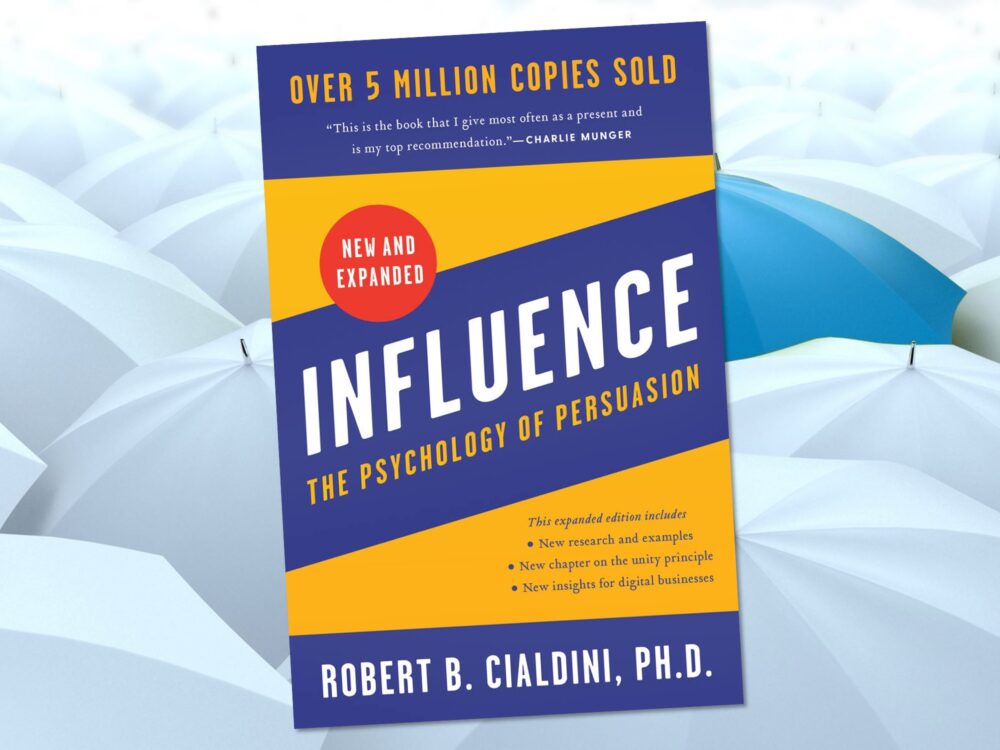
Influence: The Psychology of Persuasion by Robert B. Cialdini is an exploration of why people say “yes” and how subtle psychological triggers shape our decisions. Drawing on decades of research, Cialdini identifies the core principles that guide human behaviour, often without our conscious awareness, and illustrates them with lively anecdotes from marketing, politics, and everyday life. The tone is accessible, the examples are memorable, and the insights are immediately recognisable.
At its core, the book is both enlightening and cautionary. Cialdini shows how these persuasive mechanisms can be used ethically to communicate more effectively, but also how they can be misused to manipulate. His aim is not to turn readers into master manipulators, but to help them recognise the invisible levers that influence their choices. The result is a thoughtful, occasionally unsettling, but ultimately empowering read.
Synopsis
The book spans 336 pages and nine chapters, each dedicated to one of the psychological levers that shape human decision-making.
Chapter 1 – Levers of Influence: (Power) Tools of the Trades
Cialdini introduces the idea that humans rely on mental shortcuts, i.e. automatic responses that help us navigate a complex world. These shortcuts are efficient but also make us vulnerable to influence. He sets the stage by explaining why understanding these mechanisms is essential in a world overflowing with persuasive messages.
Chapter 2 – Reciprocation: The Old Give and Take
This chapter explores the powerful social rule that obliges us to return favours. Cialdini shows how this instinct, which helps maintain social harmony, can be exploited. Examples range from free samples in shops to strategic “gifts” in negotiations. He illustrates how difficult it is to resist the urge to reciprocate, even when the initial gesture was neither requested nor particularly welcome.
Chapter 3 – Liking: The Friendly Thief
Cialdini explains why we are more likely to comply with people we like, whether because of physical attractiveness, similarity, compliments, or familiarity. He demonstrates how salespeople, politicians, and even con artists use charm and rapport to lower our defences, often with surprising ease.
Chapter 4 – Social Proof: Truths Are Us
This chapter focuses on our tendency to look to others when we are uncertain. If everyone else seems to approve something, we assume it must be good. Cialdini shows how this principle drives trends, shapes public behaviour, and can even lead to dangerous herd mentality.
Chapter 5 – Authority: Directed Deference
Cialdini examines why we obey authority figures, often without question. Drawing on famous experiments and real-world examples, he shows how titles, uniforms, and symbols of expertise can trigger compliance, even when the authority is questionable or entirely fabricated.
Chapter 6 – Scarcity: The Rule of the Few
This chapter explains why we value things more when they are rare or limited. Whether it’s a “limited-time offer” or a product that is “almost sold out”, scarcity creates urgency and desire. Cialdini highlights how marketers use this principle to push us into quick, emotional decisions.
Chapter 7 – Commitment and Consistency: Hobgoblins of the Mind
Cialdini explores our deep need to appear consistent with our past actions and statements. Once we commit to something (publicly or even privately) we feel pressure to stick with it. This principle can be used for good (building habits) or for manipulation (getting people to agree to bigger requests after a small initial one).
Chapter 8 – Unity: The “We” Is the Shared Me
A later addition to the new edition of the book, this chapter discusses the persuasive power of shared identity. When we feel someone is part of our “tribe”, we are far more likely to trust and follow them. Cialdini shows how belonging, kinship, and group identity shape our decisions in profound ways.
Chapter 9 – Instant Influence: Primitive Consent for an Automatic Age
The final chapter ties everything together, arguing that modern life, with its speed and information overload, makes us more reliant on automatic responses. Cialdini warns that while these shortcuts are useful, they also make us easier targets for manipulation, and he encourages readers to cultivate awareness and critical thinking.
Why you should read it
For the general public, the book is a practical guide to understanding how persuasion works in everyday life. It helps readers recognise when they are being nudged, coaxed, or pressured, and offers tools to resist unwanted influence. The examples are relatable, the writing is lively, and the insights are immediately applicable, from shopping decisions to workplace dynamics.
For professionals, the book provides a structured framework for ethical persuasion. Cialdini’s principles are widely used in behavioural science, communication strategy, and organisational psychology. Reading it is almost compulsory for anyone whose work involves influencing others or understanding human behaviour.
Critics and review
Influence has been widely praised since its first publication and is now considered a foundational text in psychology and behavioural science. Critics have highlighted its clarity, strong research base, and engaging storytelling. It has been adopted in universities, used in corporate training, and cited in countless academic papers. Its influence extends far beyond psychology into marketing, politics, and public policy.
The book enjoys consistently high ratings across major platforms. On Goodreads, it holds an impressive 4.22 rating from over 160,000 readers. On Amazon, it is described as a major bestseller with more than four million copies sold and remains one of the most recommended books in its category. While some critics argue that the examples can feel dated or that the principles are now widely known, the consensus remains overwhelmingly positive.
Verdict
Cialdini’s Influence is a rare combination of rigorous science and engaging storytelling. It is insightful without being heavy, practical without being simplistic, and entertaining without losing academic credibility. Whether you want to understand others better or simply avoid being manipulated, this book offers a toolkit that is as relevant today as when it was first published.
About the author
Robert B. Cialdini is a social psychologist and Professor Emeritus at Arizona State University, known internationally for his research on persuasion, compliance, and negotiation. His academic work spans more than three decades and has shaped modern understanding of how influence works. He has held visiting appointments at institutions such as Stanford, Columbia, and the University of California, and is one of the most cited living social psychologists in his field.
Beyond Influence, Cialdini has authored and co-authored several other influential works, including Pre-Suasion and Yes! 50 Scientifically Proven Ways to Be Persuasive. He also runs a consultancy, Influence at Work, which advises organisations on ethical persuasion strategies. While he is generally well-regarded, some critics have questioned the commercialisation of his research, arguing that it risks blurring the line between academic insight and marketing practice. Nonetheless, his reputation as a leading authority on persuasion remains firmly intact.