
Overview
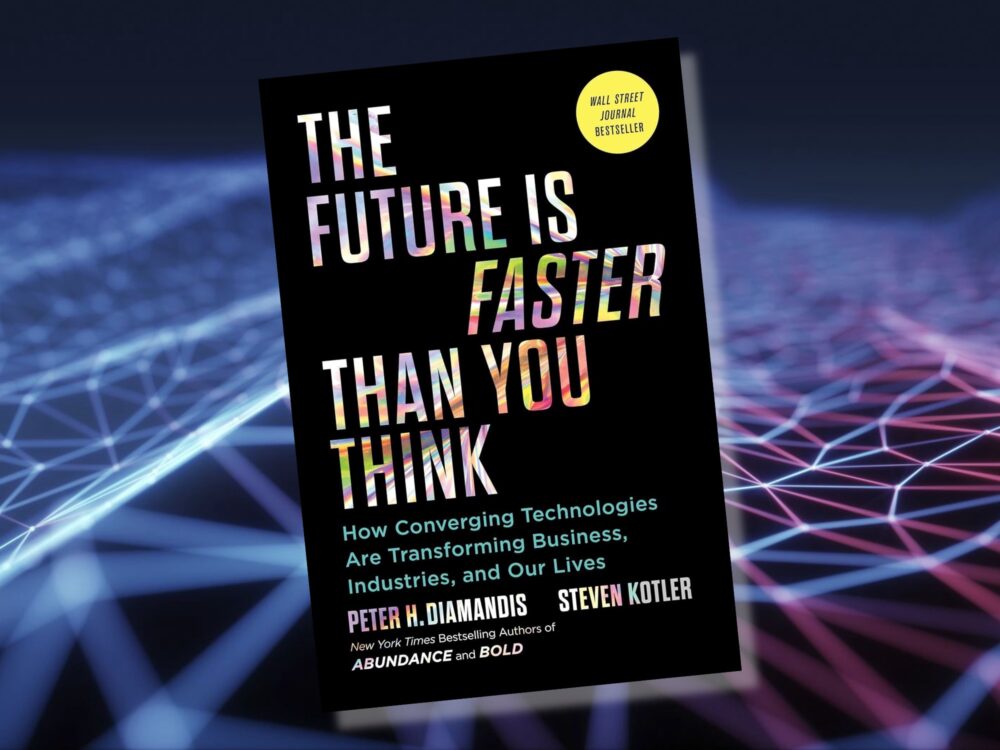
“The Future Is Faster Than You Think: How Converging Technologies Are Transforming Business, Industries, and Our Lives,” written by Steven Kotler and Peter H. Diamandis, delves into the profound impact of rapidly advancing technologies on various aspects of our lives. The book explores how technological convergence, involving AI, robotics, virtual reality, digital biology, and more, is revolutionising industries, reshaping businesses, and transforming society. The authors provide a comprehensive roadmap for understanding the future landscape, investigating the potential of these advancements to create unprecedented growth and disruption.
Throughout the book, Kotler and Diamandis examine the implications of these technological changes on everyday life, from transportation and healthcare to education and entertainment. They highlight how the acceleration of technology is catalysing a new era of innovation, predicting that the next decade will bring more significant changes than the past century. By emphasising the importance of staying ahead of these trends, the book serves as a guide for individuals and organisations to navigate the challenges and opportunities of the fast-evolving technological world.
Synopsis
The book is divided into three parts with a total of fourteen chapters.
PART ONE: THE POWER OF CONVERGENCE
- Chapter One: Convergence – This chapter introduces the concept of converging technologies and how the intersection of different innovations, such as AI, robotics, and digital biology, is creating a significantly transformative impact on society.
- Chapter Two: The Jump to Lightspeed: Exponential Technologies Part I – The authors delve into the initial set of exponential technologies driving rapid change. They explain how advancements in fields like artificial intelligence and robotics are accelerating at a breakneck pace, reshaping industries and daily life.
- Chapter Three: The Turbo-Boost: Exponential Technologies Part II – Continuing from the previous chapter, this part discusses the next wave of exponential technologies, including biotechnology, blockchain, and quantum computing, and their potential to disrupt traditional business models.
- Chapter Four: The Acceleration of Acceleration – Here, the concept of “the acceleration of acceleration” is explored, highlighting how the rate of technological progress itself is increasing, leading to unprecedented speed and scale of innovation.
PART TWO: THE REBIRTH OF EVERYTHING
- Chapter Five: The Future of Shopping – This chapter examines the transformation of the retail industry, driven by technologies like augmented reality, robotics, and AI, which create immersive, personalised shopping experiences.
- Chapter Six: The Future of Advertising – The focus shifts to the advertising sector, exploring how data analytics, AI, and personalised marketing strategies are revolutionising how brands connect with consumers.
- Chapter Seven: The Future of Entertainment – The authors discuss the evolution of entertainment, from virtual reality to personalised content, illustrating how technology is enhancing and transforming the way we consume media.
- Chapter Eight: The Future of Education – This chapter reimagines the education system with the integration of AI and virtual learning environments, proposing a more personalised and accessible approach to education.
- Chapter Nine: The Future of Healthcare – The future of healthcare is dissected, showcasing how technologies like telemedicine, wearables, and AI are poised to revolutionise patient care and medical practices.
- Chapter Ten: The Future of Longevity – Exploring advancements in health sciences and biotechnology, this chapter discusses the potential for extending human lifespan and improving quality of life through innovation.
- Chapter Eleven: The Future of Insurance, Finance, and Real Estate – The authors explain how technologies such as blockchain, AI, and the Internet of Things are transforming the landscape of insurance, finance, and real estate, making these sectors more efficient and transparent.
- Chapter Twelve: The Future of Food – This chapter addresses the future of food production and consumption, highlighting innovations in agriculture tech, alternative proteins, and sustainable farming practices.
PART THREE: THE FASTER FUTURE
- Chapter Thirteen: Threats and Solutions – The penultimate chapter tackles the potential threats posed by rapid technological advancement, from cybersecurity challenges to ethical considerations, and proposes solutions to mitigate these risks.
- Chapter Fourteen: The Five Great Migrations – The final chapter discusses the anticipated “five great migrations” driven by technological progress, encompassing shifts in human population, economic power, digital connectivity, environmental changes, and cultural transformations.
Why you should read it?
“The Future Is Faster Than You Think” is a must-read for both the general public and specialised audiences because it provides a comprehensive and accessible insight into the rapid advancements of converging technologies. For the general public, the book demystifies complex concepts such as artificial intelligence, robotics, and biotechnology, presenting them in an engaging and easy-to-understand manner. It highlights how these technologies are not only shaping industries but also transforming everyday life, from shopping and entertainment to healthcare and education. By bridging the gap between science fiction and reality, the book empowers readers with knowledge about the technological future that awaits them, making it easier to understand and adapt to the inevitable changes.
For professionals and experts, the book offers valuable foresight into the disruptive potential of exponential technologies across various sectors. It delves into the intricacies of these advancements, providing detailed analyses and real-world examples that demonstrate their impact. The book serves as a strategic guide for businesses and industry leaders, offering actionable insights on how to leverage these technologies to stay ahead of the curve. The emphasis on case studies and practical applications makes it a resourceful tool for understanding the opportunities and challenges presented by the fast-paced technological landscape. Whether you are an industry expert or simply curious about the future, this book equips you with the knowledge and perspective needed to navigate and thrive in an ever-evolving world.
Critics and review
“The Future Is Faster Than You Think” has garnered a generally positive reception from both readers and critics. With an average rating of 4.15 on Goodreads and 4.7 on Amazon, the book has been praised for its insightful and forward-thinking perspective on the convergence of various technologies. Reviews from Kirkus describe the book as “welcome reading for futurists and technogeeks,” while Financial Express highlights its ambitious predictions.
Despite this, it’s important to acknowledge that books of this nature often fall victim to “technology optimism.” They can be overly optimistic about the extent and speed of technological advancements while underestimating potential negative consequences.
What’s more, these books may age poorly due to their specific predictions about the future, many of which may not materialise as anticipated. Nevertheless, despite these limitations, such books are invaluable as they provide a roadmap to navigating the potential futures shaped by technological change. Their importance lies not only in highlighting the exciting possibilities of the future but also in sparking dialogue on how to manage and mitigate the associated risks.
Even with their shortcomings, they offer readers a thought-provoking glimpse into the world of tomorrow and encourage us to prepare for a rapidly evolving technological landscape.
Verdict
“The Future Is Faster Than You Think” offers a compelling vision of how converging technologies will shape the next decade, blending scientific insights with thought-provoking predictions. While its optimistic tone and ambitious forecasts may occasionally overshoot reality, the book remains a valuable roadmap for understanding the profound impact of technological advancements. It serves as both an eye-opener and a conversation starter, encouraging readers to prepare for the rapid changes ahead while considering the potential benefits and challenges of an increasingly tech-driven world.
About the authors
Steven Kotler is a renowned author, journalist, and entrepreneur, best known for his work in the field of human performance. As the executive director and co-founder of the Flow Research Collective, Kotler focuses on the neurobiology of peak performance, exploring what happens in the brain and body when individuals reach their optimal state. Kotler’s notable works include “The Art of Impossible,” “The Rise of Superman,” “Abundance,” “Bold,” and “Stealing Fire,” among others. His research and writing often intersect the domains of neuroscience, psychology, and technology, aiming to unlock human potential and enhance productivity. Additionally, Kotler and his wife Joy Nicholson co-founded Rancho de Chihuahua, a sanctuary for special-needs dogs, reflecting his passion for both human and animal well-being.
Peter H. Diamandis is a pioneer in innovation, incentive competitions, and commercial space. As the founder and executive chairman of the XPRIZE Foundation, he has designed and overseen competitions to solve global challenges. Diamandis co-founded Human Longevity, Inc., focusing on extending healthy human lifespans through genomics and cell therapy. He is also known for co-founding Singularity University and Planetary Resources, a company specialising in asteroid mining. Among his notable publications are “Abundance,” “BOLD,” and “The Future Is Faster Than You Think,” co-authored with Steven Kotler. Diamandis’ work is sometimes marred by controversy, including holding a superspreader event during the COVID-19 pandemic and promoting unapproved treatments for the virus. Despite these controversies, his achievements in driving technological progress and addressing global challenges remain highly impactful.