Overview
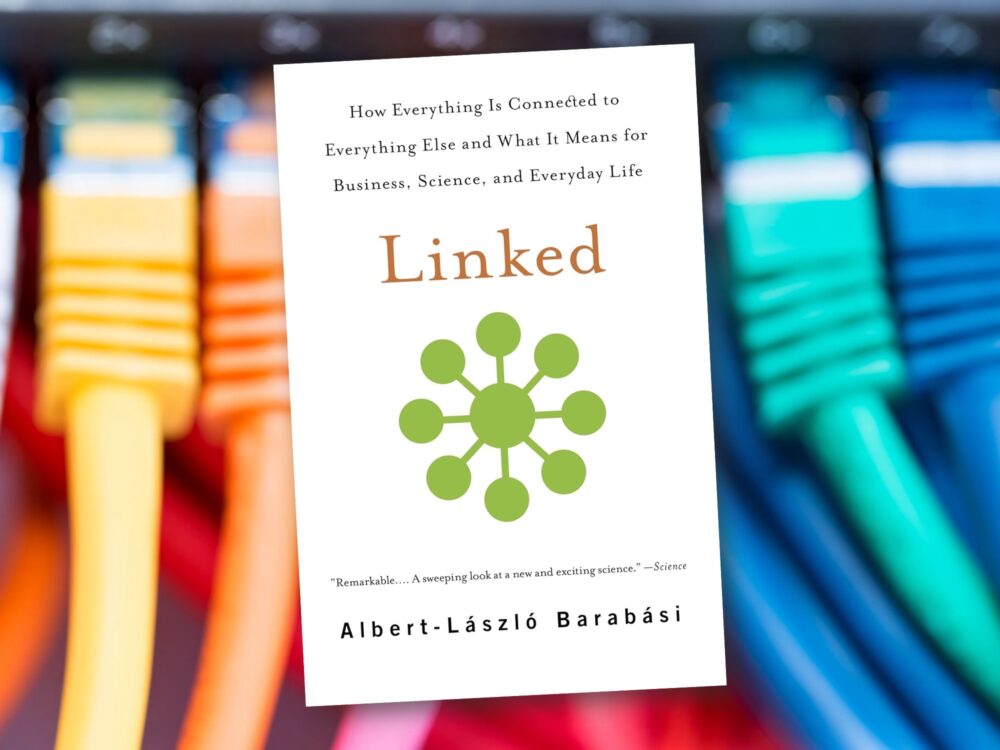
Albert-László Barabási’s Linked: The New Science of Networks is a popular science book that explores how networks shape our world, from friendships and the internet to biology and economics. Written in accessible language, it introduces readers to the surprising order hidden behind seemingly random connections.
The book is both a scientific journey and a detective story, showing how simple rules explain complex systems. Barabási’s enthusiasm is contagious, though occasionally he risks oversimplifying. Still, it’s a lively introduction to a field that has changed how we understand society, technology, and even life itself.
Synopsis
The book runs to about 280 pages and 15 chapters (plus an Afterlink). Each chapter, called a “link”, builds on the idea that networks are everywhere.
- The First Link: Introduction – Sets the stage by arguing that networks are the hidden architecture of nature, society, and technology.
- The Second Link: The Random Universe – Explains early models of random networks and why they fail to capture real-world complexity.
- The Third Link: Six Degrees of Separation – Revisits Milgram’s famous experiment, showing how surprisingly short paths connect people worldwide.
- The Fourth Link: Small Worlds – Introduces the “small-world phenomenon”, where clusters of connections still allow global reach.
- The Fifth Link: Hubs and Connectors – Highlights the importance of hubs (highly connected nodes) in keeping networks together.
- The Sixth Link: The 80/20 Rule – Applies Pareto’s principle to networks, showing how a minority of nodes dominate activity.
- The Seventh Link: Rich Get Richer – Explains preferential attachment: why popular nodes attract more links, reinforcing inequality.
- The Eighth Link: Einstein’s Legacy – Discusses scientific collaboration networks and how ideas spread across disciplines.
- The Ninth Link: Achilles’ Heel – Warns that networks are robust against random failure but vulnerable to targeted attacks.
- The Tenth Link: Viruses and Fads – Explores how diseases, rumours, and fashions spread through social networks.
- The Eleventh Link: The Awakening Internet – Charts the explosive growth of the web and its underlying structure.
- The Twelfth Link: The Fragmented Web – Examines how the internet can fracture into isolated clusters.
- The Thirteenth Link: The Map of Life – Looks at biological networks, from genes to proteins, and their role in health.
- The Fourteenth Link: Network Economy – Applies network theory to markets, firms, and global trade.
- The Last Link: Web Without a Spider – Reflects on decentralised systems without central control.
- Afterlink: Hierarchies and Communities – Concludes with how networks form communities and hierarchies, balancing order and chaos.
Why you should read it?
For the general reader, Linked is a gateway into seeing the world differently. After reading, you’ll never look at friendships, Google searches, or even your fridge magnets in quite the same way. It’s entertaining, eye-opening, and surprisingly practical.
For specialists, the book offers a digestible overview of network science’s foundations. While not mathematically heavy, it provides conceptual clarity and historical context. It’s a useful reminder that behind the equations lie stories of discovery, rivalry, and intellectual adventure.
Critics and review
The book was widely praised as an engaging introduction to a new science. Nature called it “entertaining” and “enthusiastic”, while Science found it “revealing and thought-provoking”. Critics admired its ability to popularise a complex field without drowning readers in jargon.
On platforms, Linked enjoys solid reviews both on GoodReads and Amazon, where readers highlight its clarity and breadth. Some note that later chapters feel rushed, but overall it remains a respected classic of popular science.
Verdict
Linked is a lively, insightful book that succeeds in making network science accessible. It occasionally glosses over technical detail, but its storytelling and enthusiasm more than compensate. A must-read if you want to understand why “everything is connected to everything else”.
About the author
Albert-László Barabási (born 1967 in Transylvania, Romania) is a Hungarian-American physicist renowned for pioneering network science. He discovered scale-free networks and proposed the Barabási–Albert model, which explains why hubs dominate systems from the web to biology.
He has published widely, including Bursts (2010), Network Science (2016), and The Formula (2018) (see my review here). He directs the Center for Complex Network Research at Northeastern University and holds appointments at Harvard Medical School. Controversies around him are minor, mostly debates over the limits of network models, but his influence on science is undisputed.