

Overview
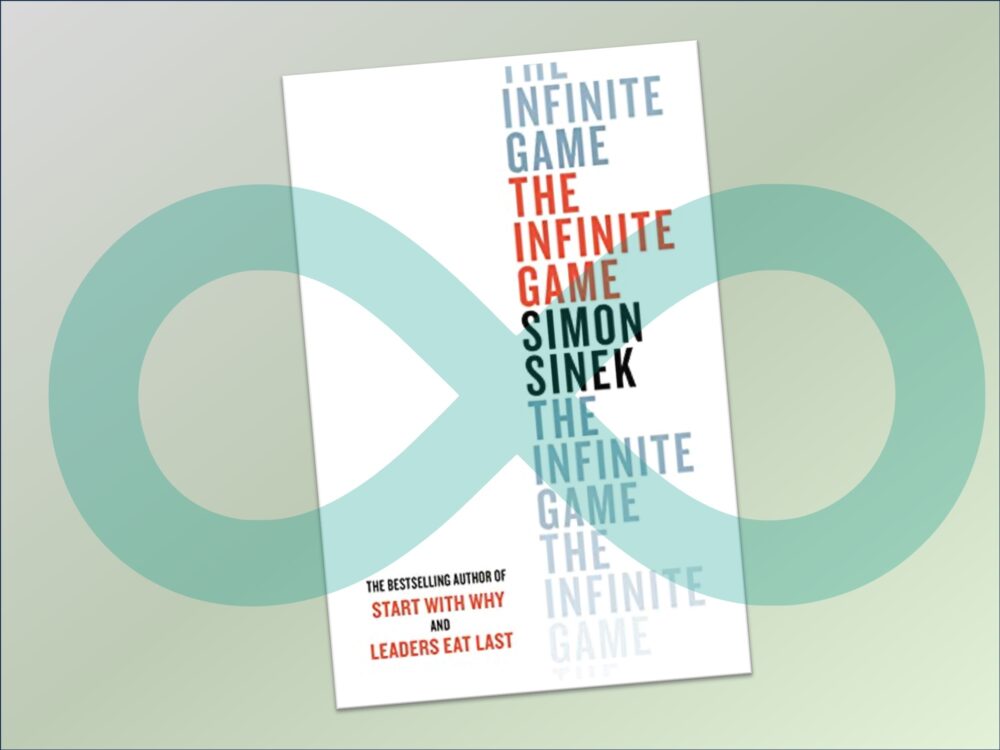
Simon Sinek’s The Infinite Game explores the idea that many of life’s biggest arenas, business, politics, leadership, even personal development, are not competitions to be “won” but ongoing, evolving games with no fixed endpoint. Drawing inspiration from philosopher James P. Carse, Sinek argues that leaders who adopt an “infinite mindset” build stronger organisations, inspire greater trust, and create more resilient cultures.
Across the book, he contrasts short‑term, numbers‑driven thinking with long‑term purpose, responsibility, and adaptability. His message is simple but ambitious: if we stop obsessing about beating the competition and instead focus on advancing a meaningful cause, we will not only perform better but also contribute to healthier, more sustainable organisations and societies.
Synopsis
The book spans 251 pages and 11 chapters, each exploring a key principle of the “infinite mindset” and how leaders can apply it in practice.
Chapter 1 – Finite and infinite games
Sinek introduces the core distinction between finite games (with fixed rules and clear winners) and infinite games (with shifting rules and no endpoint). He argues that many organisations mistakenly use finite strategies in infinite contexts, leading to stress, short‑termism, and poor decision‑making. The chapter sets the philosophical foundation for the rest of the book.
Chapter 2 – Just cause
Here Sinek explains that infinite players are driven by a “Just Cause”, a purpose so inspiring that people are willing to make sacrifices to advance it. He outlines the characteristics of a strong cause: it must be inclusive, service‑oriented, resilient, and idealistic. Without such a cause, organisations drift into aimless competition.
Chapter 3 – Cause, no cause
This chapter explores what happens when organisations claim to have a purpose but fail to live it. Sinek highlights the difference between a genuine cause and a marketing slogan, showing how misalignment erodes trust and credibility. He uses examples of companies that talk about values but behave in ways that contradict them.
Chapter 4 – Keeper of the cause
Sinek argues that leaders must act as guardians of the organisation’s purpose. Their role is not merely operational but custodial: they must protect the cause from being diluted by short‑term pressures. He emphasises stewardship over authority, suggesting that true leadership is about safeguarding the organisation for future generations.
Chapter 5 – The responsibility of business (revised)
This chapter challenges the idea that the primary duty of business is to maximise shareholder value. Sinek critiques narrow financial thinking and advocates for a broader responsibility: to serve employees, customers, and society. He argues that businesses thrive when they prioritise long‑term health over quarterly results.
Chapter 6 – Will and resources
Sinek distinguishes between “will” (the human motivation to pursue a cause) and “resources” (the money, tools, and assets needed to support it). Infinite‑minded leaders, he says, prioritise will over resources, because motivated people can overcome resource limitations, but abundant resources cannot compensate for a lack of purpose.
Chapter 7 – Trusting teams
This chapter focuses on psychological safety. Sinek argues that teams perform best when people feel safe to admit mistakes, ask for help, and express concerns. He contrasts environments of fear, where people hide problems, with environments of trust, where issues are addressed early and honestly.
Chapter 8 – Ethical fading
Sinek examines how organisations gradually drift into unethical behaviour, often without malicious intent. He explains how pressure, competition, and poorly designed incentives can cause people to justify small compromises that eventually become major scandals. The chapter serves as a warning against complacency.
Chapter 9 – Worthy rival
Instead of treating competitors as enemies, Sinek suggests viewing them as “worthy rivals” who reveal our weaknesses and push us to improve. He argues that rivalry should be a source of learning, not hostility. This mindset reduces anxiety and encourages continuous development.
Chapter 10 – Existential flexibility
This chapter explores the willingness to make bold, disruptive changes, even at the cost of short‑term loss, to stay aligned with the “Just Cause”. Sinek highlights companies that reinvented themselves to remain relevant, contrasting them with those that clung to old models and declined.
Chapter 11 – The courage to lead
Sinek concludes by arguing that adopting an infinite mindset requires courage: courage to prioritise long‑term purpose over short‑term wins, to challenge conventional metrics, and to lead with empathy and integrity. He frames leadership as a moral choice rather than a technical skill.
Why you should read it
For the general reader, The Infinite Game offers a refreshing perspective on success and leadership. It encourages you to step back from the daily rush and rethink what “winning” really means in life and work. The book is accessible, engaging, and peppered with stories that make the concepts easy to grasp, even if you’re not a business expert.
For professionals, managers, and organisational leaders, the book provides a useful framework for long‑term thinking. It challenges conventional business logic and invites readers to build healthier, more resilient organisations. Whether you work in corporate strategy, public service, education, or entrepreneurship, Sinek’s ideas can help you design systems that endure rather than merely perform.
Critics and review
The book received a mixed but generally positive reception. Many readers praised its clarity, inspirational tone, and relevance to modern leadership challenges. Critics, however, noted that some ideas feel repetitive or less original than Sinek’s earlier works, with several reviewers pointing out that the book revisits themes from Start with Why and Leaders Eat Last without adding substantial new insights.
On rating platforms, the book performs strongly. On Goodreads, it holds an average rating of 4.16 out of 5, based on more than 28,000 ratings. Reviews on Amazon are similarly positive, with many readers appreciating its long‑term perspective and practical leadership lessons.
Verdict
The Infinite Game is an inspiring and thought‑provoking book that encourages leaders to look beyond short‑term wins and focus on building meaningful, sustainable organisations. While some ideas may feel familiar to long‑time Sinek readers, the book’s central message is powerful, timely, and delivered with Sinek’s trademark clarity. It is not a flawless masterpiece, but it is a valuable and uplifting read for anyone interested in leadership, purpose, and long‑term thinking.
About the author
Simon Sinek is a British‑American author, speaker, and leadership consultant known for his work on organisational culture, purpose, and motivation. He rose to global prominence with his TED Talk “Start with Why,” one of the most‑watched TED Talks of all time. His work focuses on helping leaders inspire trust, cooperation, and long‑term thinking within their organisations. He has collaborated with major companies, government agencies, and the military, offering guidance on leadership and communication.
Sinek has written several bestselling books, including Start with Why, Leaders Eat Last, and Together Is Better. His work is widely praised for its accessibility, though some critics argue that his ideas can be overly simplified or idealistic. He has also faced occasional criticism for relying heavily on anecdotal evidence rather than rigorous academic research. Nevertheless, he remains one of the most influential voices in contemporary leadership thinking.


Leave a Reply