

Overview
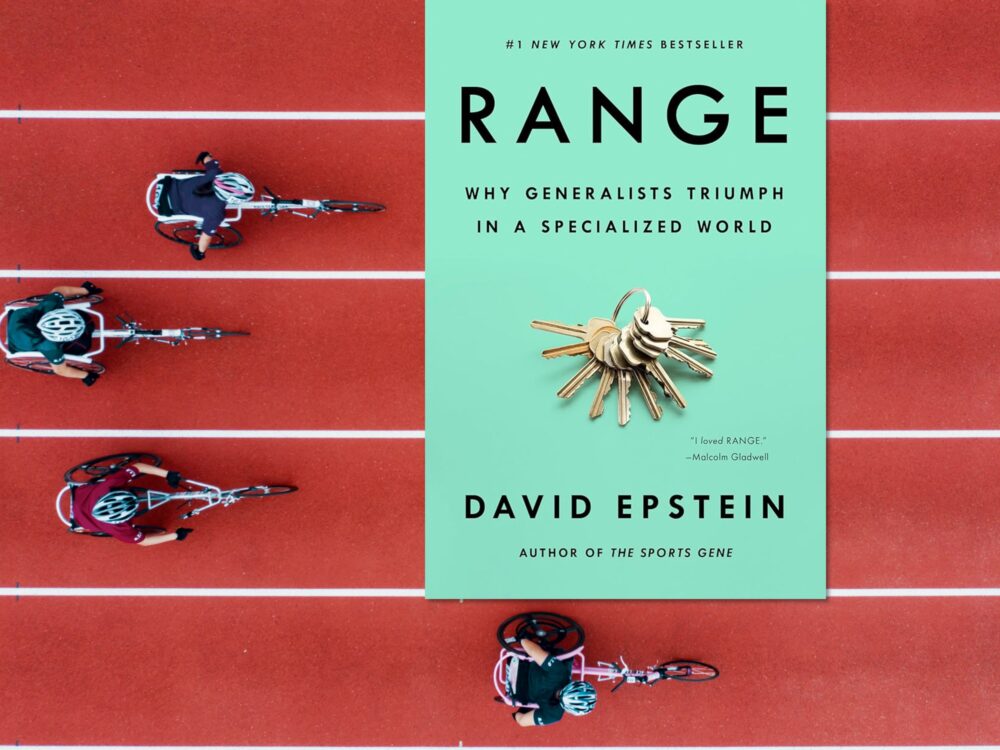
David Epstein’s Range: Why Generalists Triumph in a Specialised World argues that, despite society’s obsession with early specialisation, the people who thrive in complex, unpredictable environments are often those with broad experience, curiosity, and the willingness to experiment. Epstein challenges the comforting myth that success follows a straight line, showing instead that meandering paths, false starts, and diverse interests can be powerful assets.
The book blends scientific research, case studies, and storytelling to demonstrate that generalists are often better equipped to solve novel problems, make creative connections, and adapt to change. While Epstein clearly admires the power of breadth, he does not dismiss specialists. Rather, he shows that the world needs both, just not in the proportions we often assume.
Synopsis
The book spans 352 pages and 12 chapters plus an introduction and conclusion. The essence of the various chapters is the following:
Introduction: Roger vs. Tiger
Epstein opens with the contrasting childhoods of Roger Federer and Tiger Woods to illustrate two paths to mastery: early, intense specialisation versus late-blooming exploration. He uses this comparison to question the widespread belief that early specialisation is always the superior route to excellence.
Chapter 1: The cult of the head start
This chapter examines society’s obsession with early achievement and the belief that starting young guarantees success. Epstein argues that while this may hold true in narrow, predictable fields, it often fails in complex environments where adaptability and broad thinking matter more.
Chapter 2: How the wicked world was made
Epstein introduces the idea of “kind” versus “wicked” learning environments. Kind environments offer clear rules and immediate feedback, while wicked ones are unpredictable and messy. Most real-world challenges fall into the latter category, making generalist thinking more valuable.
Chapter 3: When less of the same is more
Here Epstein shows how stepping outside one’s domain can lead to better solutions than simply doubling down on the same methods. He highlights examples where cross-disciplinary thinking outperforms narrow expertise.
Chapter 4: Learning, fast and slow
This chapter explores how people learn in different contexts. Epstein argues that slow, effortful learning, often gained through varied experiences, creates deeper understanding than rapid, repetitive practice.
Chapter 5: Thinking outside experience
Epstein demonstrates how individuals who draw on diverse experiences are better at solving unfamiliar problems. He uses examples from science, business, and the arts to show how unconventional backgrounds can spark innovation.
Chapter 6: The trouble with too much grit
While grit is fashionable, Epstein warns that stubborn persistence can sometimes trap people in unproductive paths. He argues that quitting, pivoting, or exploring alternatives can be smarter than grinding endlessly.
Chapter 7: Flirting with your possible selves
This chapter encourages experimentation with different identities and careers. Epstein shows that trying out various roles helps people discover what truly suits them, rather than forcing premature commitments.
Chapter 8: The outsider advantage
Epstein highlights how outsiders often make breakthroughs because they are not constrained by conventional thinking. Fresh eyes can spot what insiders overlook.
Chapter 9: Lateral thinking with withered technology
This chapter explores how old or “withered” technologies can inspire new ideas when viewed from unexpected angles. Epstein shows how creative recombination often beats cutting-edge innovation.
Chapter 10: Fooled by expertise
Epstein examines the limits of expertise, especially in unpredictable environments. Experts can become overconfident, misled by patterns that no longer apply, or blind to alternative perspectives.
Chapter 11: Learning to drop your familiar tools
This chapter argues that clinging to familiar methods can be dangerous. Epstein uses examples from aviation, firefighting, and business to show how flexibility and humility can save lives.
Chapter 12: Deliberate amateurs
Epstein celebrates the “deliberate amateur”, curious, playful, and willing to learn for its own sake. He argues that maintaining an amateur mindset fosters creativity and resilience.
Conclusion: Expanding your range
Epstein concludes by encouraging readers to embrace breadth, curiosity, and experimentation. He argues that in a rapidly changing world, range is not a luxury but a necessity.
Why you should read it
For the general public, Range is a refreshing antidote to the pressure to specialise early and stick to one path. It reassures readers that wandering, experimenting, and changing direction are not signs of failure but natural parts of growth. The book is full of engaging stories that make complex ideas accessible without ever feeling simplistic.
For specialists, professionals, and academics, the book offers a valuable reminder that expertise has limits and that cross-disciplinary thinking can unlock new insights. It encourages experts to broaden their horizons, collaborate across fields, and cultivate intellectual humility. These are skills increasingly essential in today’s interconnected world.
Critics and review
Range was widely praised for its engaging storytelling, strong research base, and timely message. Reviewers highlighted Epstein’s ability to weave scientific studies with real-world examples in a way that feels both rigorous and entertaining. Some critics noted that the book occasionally overstates its case or cherry-picks examples, but even sceptics acknowledged its thought-provoking nature.
On major platforms, the book has been well received. On Goodreads, it holds a rating of 4.13 out of 5 from over 79,000 ratings. Reviews on Amazon are similarly positive, often praising its clarity and relevance in a world that increasingly values adaptability.
Verdict
Range is a compelling, well-researched, and highly readable book that challenges conventional wisdom about success and expertise. While it occasionally leans a bit heavily on its central thesis, it remains a thoughtful, inspiring, and often entertaining argument for embracing breadth in a world obsessed with depth. Whether you are a specialist, a generalist, or someone still figuring it out, the book offers valuable insights and a comforting reminder that it is perfectly fine not to have everything figured out from the start.
About the author
David Epstein is an American journalist and author known for his work on science, sports, and human performance. He holds master’s degrees in environmental science and journalism and has worked as a senior writer for Sports Illustrated and as an investigative reporter for ProPublica. His writing often explores the intersection of data, human behaviour, and performance, making complex topics accessible to a broad audience.
Epstein is also the author of The Sports Gene, a bestseller examining the role of genetics in athletic performance. His upcoming book, Inside the Box: How Constraints Make Us Better, is scheduled for publication in 2026.




Leave a Reply