
Overview
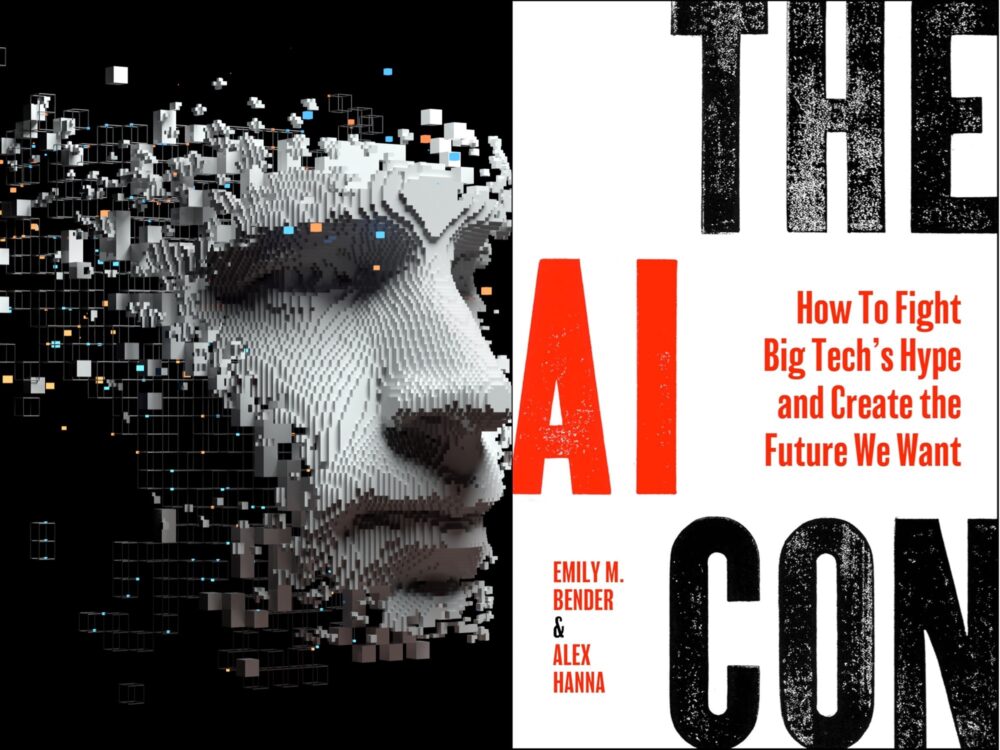
The AI Con: How to Fight Big Tech’s Hype and Create the Future We Want is a scathing, timely, and thoroughly researched dismantling of the narrative surrounding contemporary artificial intelligence. Written by computational linguist Emily M. Bender and sociologist Alex Hanna, the book takes direct aim at Silicon Valley’s marketing machine, arguing that what we call “AI” is neither intelligent nor autonomous. Instead, the authors expose these tools as clever pattern-matching algorithms, synthetic text generators, and labor-intensive automated systems wrapped in inflated rhetoric to attract venture capital and justify surveillance capitalism.
Rather than painting a sci-fi dystopia governed by sentient super-computers, the authors ground their critique in the present day. They show how the hype cycle surrounding large language models serves to concentrate corporate power, degrade working conditions, and divert attention away from real, immediate social and environmental harms. Written with a mix of academic rigour and biting wit, the book urges readers to stop treating software as a magic box and start demanding transparency, accountability, and democratic control over technology.
Synopsis
The book consists of 288 pages spread across seven structured chapters and a comprehensive introduction.
Chapter 1 – An Introduction to AI Hype
In the opening chapter, the authors set the foundation by defining what “AI hype” actually is and how Big Tech uses inflated vocabulary to manufacture authority. They unpack how anthropomorphic terms — like “learning”, “thinking”, or “reasoning” — are strategically applied to statistics-based software, tricking the public into attributing human agency to automated code.
Chapter 2 – It’s Alive! The Hype of Thinking Machines
Moving into the second chapter, the book tackles the myth of the “thinking machine”, taking a deep dive into computer science and linguistics to show that large language models are merely predicting the next likely word based on training data rather than understanding context or truth.
Chapter 3 – Leisure for Me, Gig Work for Thee: AI Hype at Work
This third chapter shifts the focus to the modern workplace, exposing how corporate executives deploy automated tools under the guise of “efficiency”. The core message here is that AI in the workplace often manifests as intense algorithmic surveillance, wage suppression, and the replacement of skilled workers with gig-economy taskers who perform hidden manual data-labelling.
Chapter 4 – If It Quacks Like a Doc: AI Hype and Social Services
Turning to the fourth chapter, the narrative examines the dangers of introducing automated decision-making into vital public sectors like healthcare, welfare, and social services. The authors highlight how unproven algorithms can automate bias, deny legitimate insurance or benefit claims, and replace compassionate human care with cost-cutting digital substitutes.
Chapter 5 – Artifice or Intelligence? AI Hype in Art, Journalism, and Science
In this fifth chapter, the authors dissect the impact of synthetic media on creative and intellectual fields, including journalism, visual arts, and scientific research. They demonstrate how automated generators rely on mass data extraction without consent, flooding digital ecosystems with synthetic noise and undermining genuine human scholarship and creative labor.
Chapter 6 – I’m Sorry, Dave, I’m Afraid I Can’t Do That: AI Doomers, AI Boosters, and Why None of That Makes Sense
Penultimately, this section critiques the media landscape, focusing on the false dichotomy between “AI Boosters” (who promise a techno-utopia) and “AI Doomers” (who warn of existential human extinction). Bender and Hanna argue that both camps are two sides of the same coin because both treat AI as an unstoppable, god-like force, ignoring the mundane, real-world harms happening right now.
Chapter 7 – Do You Believe in Hope After Hype?
Finally, in this ultimate chapter, the book offers a constructive path forward, detailing practical strategies for “strategic refusal”, media literacy, and collective action to force tech companies to respect labor, data rights, and human dignity.
Why you should read it?
For the general public, The AI Con acts as a crucial, sanity-restoring manual for navigating today’s news headlines and workplace mandates. It provides ordinary readers with the vocabulary needed to see past flashy marketing demos and corporate jargon. By demystifying how language models actually operate, the book empowers everyday consumers, workers, and news readers to ask sensible questions about the tools forced upon them, ensuring they do not feel inferior to software that is simply guessing the next word.
For a specialized audience, including software developers, tech policy makers, journalists, and educators, the book is an indispensable ethical reference. It moves beyond vague philosophical debates about hypothetical future risks and provides concrete sociological and technical analyses of data provenance, environmental costs, and systemic bias. Professionals will appreciate the rigorous frameworks for auditing automated systems and evaluating whether a digital tool truly solves a problem or merely shifts the burden onto marginalized workers.
Critics and review
The reception of The AI Con was marked by enthusiastic praise from tech ethicists, sociologists, and prominent cultural commentators, alongside, not so surprisingly, sharp pushback from Silicon Valley advocates. Critics in mainstream publications lauded the book for its sharp, myth-busting approach and its urgent call to protect human labor and civic spaces from synthetic substitutes. Reviews consistently highlighted Bender and Hanna’s ability to translate complex linguistic and technical concepts into accessible, engaging prose. However, some critics argued that the book’s intense skepticism occasionally dismisses genuine, practical utility in pattern recognition and specific data tasks, painting the tech sector with a somewhat broad brush.
On major reader platforms, the book has provoked lively debate between readers seeking tech accountability and industry enthusiasts. On Goodreads, it maintains a solid score around 3.7 out of 5 stars, where readers frequently praise its clear jargon-busting taxonomy, though a minority of reviewers feel the tone can feel overtly polemical. On Amazon, the book achieves a higher rating of approximately 4.5 out of 5 stars, with purchasers celebrating it as an essential, eye-opening read that inoculates the mind against corporate hype.
Verdict
The AI Con is a sharp, witty, and deeply necessary antidote to Silicon Valley’s loudest marketing claims. While its unrelenting skepticism may occasionally ruffle the feathers of die-hard tech optimists, it succeeds brilliantly as an accessible blueprint for reclaiming human agency, protecting worker rights, and ensuring technology serves the public interest rather than corporate profit margins.
About the authors
Dr Emily M. Bender is a Professor of Computational Linguistics at the University of Washington and one of the world’s foremost academic voices critiquing language technology. She is widely famous within the tech community as the co-author of the landmark 2021 research paper On the Dangers of Stochastic Parrots, which warned of the environmental costs, financial incentives, and linguistic biases inherent in massive language models. Her scholarship focuses on multilingual grammar engineering, computational semantics, and the societal impacts of natural language processing technology, earning her a spot on the inaugural TIME100 AI list.
Dr Alex Hanna is a sociologist and the Director of Research at the Distributed AI Research Institute (DAIR), Oakland, California. Prior to her role at DAIR, she worked as a Senior Research Scientist on Google’s Ethical AI team. Her research centers on social movements, data bias, and the political economy of machine learning systems. Together, Bender and Hanna co-host the popular podcast Mystery AI Hype Theater 3000, where they break down exaggerated media claims about technology. Both authors have faced pushback from corporate tech advocates who view their work as anti-innovation, but their insider knowledge and rigorous academic output have established them as trusted figures in global digital ethics.