
Overview
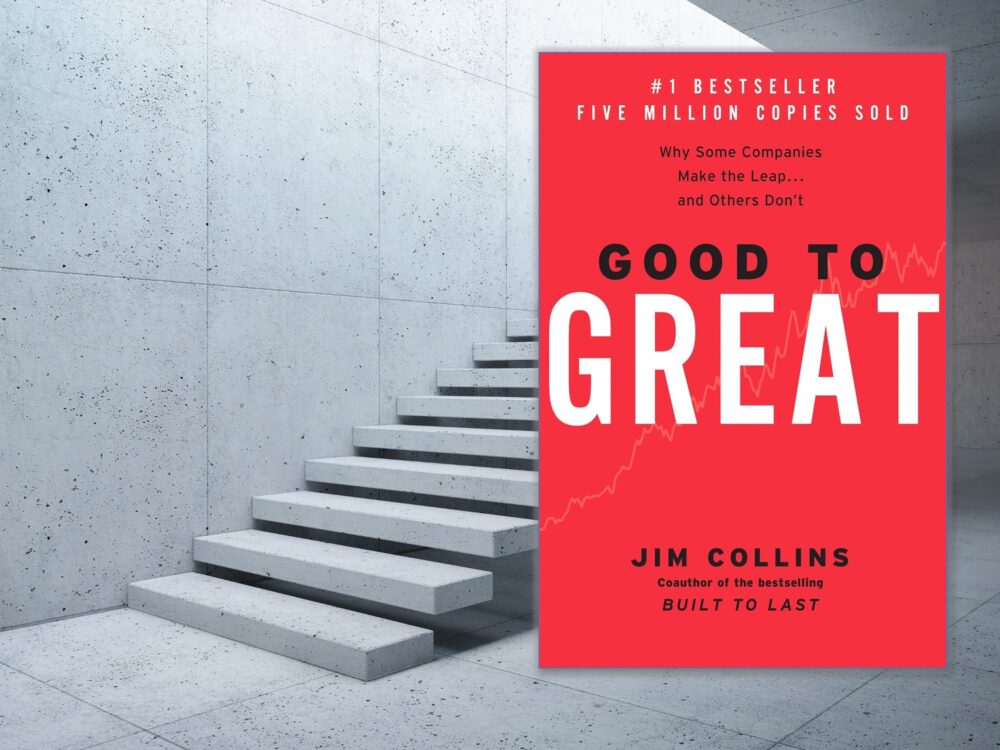
Jim Collins’ Good to Great is a business classic that explores why some companies manage to break free from mediocrity and achieve sustained excellence, while others remain stuck in the land of “just okay”. It’s based on a rigorous five-year research project that examined 1,435 companies and narrowed them down to 11 that made the leap to greatness and maintained it for at least 15 years.
The book doesn’t offer quick fixes or flashy gimmicks. Instead, it presents a framework built on disciplined people, thought and action.
Collins argues that greatness is not a matter of circumstance but of conscious choice. It’s a book that is as much about leadership and culture as it is about strategy and performance.
Synopsis
The book spans 300 pages and is organised into 9 chapters, each building on Collins’ research findings and offering a piece of the puzzle for achieving greatness.
Chapter 1: Good is the Enemy of Great
Collins sets the stage by explaining why so few companies become great. He introduces the research methodology and the idea that settling for “good enough” is the biggest barrier to greatness.
Chapter 2: Level 5 Leadership
Here we meet the surprisingly humble yet fiercely determined leaders who led the transformation. These “Level 5” leaders blend personal humility with professional will, and they’re more cardigan than cape.
Chapter 3: First Who… Then What
Forget grand strategies. Great companies start by getting the right people on board and the wrong ones off. Only then do they decide where to go. It’s a bit like assembling a dream football team before choosing the formation.
Chapter 4: Confront the Brutal Facts (Yet Never Lose Faith)
Collins introduces the “Stockdale Paradox”: face the harsh realities of your situation while maintaining unwavering belief in eventual success. No sugar-coating, just strategic optimism. Named after Admiral James Stockdale, who endured years as a prisoner of war by holding this exact mindset, it’s a lesson in how brutal realism and deep resilience can peacefully co-exist.
Chapter 5: The Hedgehog Concept
This chapter presents a simple but powerful framework: find what you’re deeply passionate about, what you can be the best at, and what drives your economic engine. Then do only that. Like a hedgehog, focus on one thing and do it brilliantly.
Chapter 6: A Culture of Discipline
Great companies combine entrepreneurial spirit with disciplined action. Bureaucracy is out, self-managed teams are in. It’s about freedom within a framework, not chaos in a beanbag.
Chapter 7: Technology Accelerators
Technology isn’t the cause of greatness, but it can help speed things up. Great companies use tech strategically, not as a magic wand.
Chapter 8: The Flywheel and the Doom Loop
Success comes from consistent effort, not dramatic breakthroughs. The “flywheel” builds momentum slowly but surely. The “doom loop” is what happens when companies chase shiny distractions.
Chapter 9: From Good to Great to Built to Last
Collins links this book to his earlier work, Built to Last, and explains how companies can sustain greatness over time. It’s the long game, not the lottery.
Why you should read it?
For the general reader, Good to Great is surprisingly accessible. You don’t need an MBA to understand it, and it’s packed with real-world examples and memorable concepts. Whether you’re leading a team, running a small business, or just curious about what separates winners from also-rans, this book offers insights that apply far beyond the boardroom.
For professionals in business, management or leadership, it’s practically required reading. Collins’ research is thorough, and his conclusions are both practical and thought-provoking. It challenges conventional wisdom and provides a framework that’s been adopted by countless organisations. If you’re serious about building something that lasts, this book is a solid foundation.
Critics and review
Good to Great was widely praised upon release and remains one of the most influential business books of the past two decades. It’s been cited by CEOs, consultants and academics alike. On Amazon, it holds an average rating of 4.6 out of 5 stars, with over 10,000 reviews. Goodreads gives it a solid 4.1 from more than 275,000 ratings.
That said, it’s not without criticism. Some reviewers argue that Collins’ selection of “great” companies was flawed, as several later declined or collapsed (Circuit City, anyone?). Others point out that correlation doesn’t equal causation, and that the book’s findings may not be universally applicable. Still, most agree that the concepts are useful, even if the examples haven’t aged perfectly.
Verdict
Good to Great is a compelling, well-researched and highly readable book that offers timeless lessons in leadership, discipline and strategic focus. While some of its case studies may have lost their shine, the core ideas remain relevant and powerful. It’s not a silver bullet, but it’s a very sharp tool.
About the author
Jim Collins is an American researcher, author and speaker who specialises in business management and company growth. He began his career at Stanford University’s Graduate School of Business, where he received the Distinguished Teaching Award. He later founded a management lab in Boulder, Colorado, where he continues to study what makes organisations thrive.
Collins has written several bestselling books, including Built to Last, Great by Choice, and How the Mighty Fall. His work is known for its rigorous research and clear frameworks. While some critics have questioned the long-term performance of his “great” companies, Collins has defended his methodology and continues to be a respected voice in the field of leadership and strategy.