
Overview
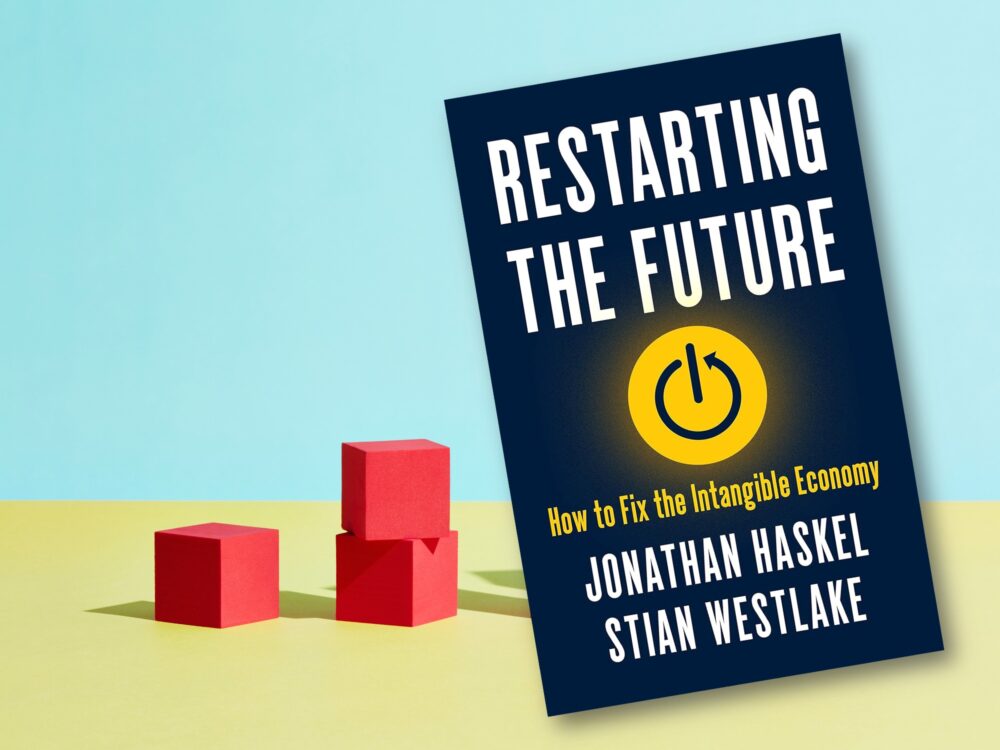
Restarting the Future: How to Fix the Intangible Economy by Jonathan Haskel and Stian Westlake explores why modern economies, despite technological advances and abundant capital, have struggled with sluggish growth, inequality, and institutional stagnation. The authors argue that the root cause lies in our failure to adapt to an economy increasingly driven by intangible assets: things like software, branding, design, data, and organisational know-how. These assets behave differently from physical ones: they’re hard to value, easy to replicate, and often generate spillovers that traditional economic frameworks struggle to accommodate.
Haskel and Westlake affirm that while the economy has evolved, our institutions (such as financial systems, tax codes, and intellectual property laws) remain stuck in a world built for tangible capital. The book offers a bold yet practical roadmap for reform, suggesting ways to reshape policy and investment to better support innovation, productivity, and fairness in an intangible age.
Synopsis
The book Restarting the Future spans just over 300 pages and is structured into seven chapters plus an introduction and conclusion, divided into two main parts: diagnosing the problem and proposing solutions for the intangible economy.
Introduction: How to Restart the Century
The authors set the stage by asking why, despite technological progress, economic growth has slowed and inequality has risen. They argue that the root cause lies in our failure to adapt institutions to an economy increasingly built on intangible assets like software, data, and organisational know-how.
Part I: What’s Gone Wrong, and Why?
- Chapter 1: The Great Economic Disappointment
This chapter outlines the symptoms of economic malaise in developed countries — sluggish productivity, rising inequality, and political instability — and challenges the idea that these are temporary or purely cyclical problems. - Chapter 2: The Economic Crisis Is an Intangibles Crisis
Here, Haskel and Westlake explain how the shift from tangible to intangible capital has changed the rules of the game. Intangibles behave differently: they scale easily, spill over to others, and are hard to value — making them poorly served by traditional economic systems. - Chapter 3: The Intangibles Crisis: Institutional Failure
The authors argue that our institutions — from financial markets to tax systems — were designed for a tangible economy and now struggle to support intangible investment. This mismatch, they say, is at the heart of today’s economic stagnation.
Part II: Fixing Our Changed Economy
- Chapter 4: “The Progress of Science and Useful Arts”: Reforming Public Investment and Intellectual Property
This chapter explores how public funding for research and development, and the rules around intellectual property, need to be updated to better support innovation in an intangible-rich world. - Chapter 5: Financial Architecture: Finance and Monetary Policy in an Intangibles-Rich Economy
The authors examine how financial systems and central banks can be reformed to better fund intangible-heavy firms, which often lack the physical collateral traditional finance relies on. - Chapter 6: Making Cities Work Better
Recognising that cities are hubs for intangible activity, this chapter looks at how urban policy — from housing to transport — can be reshaped to support collaboration, innovation, and productivity. - Chapter 7: Reducing Dysfunctional Competition
The final chapter in Part II tackles how competition policy must evolve to deal with the dominance of firms built on intangibles, where network effects and data advantages can entrench market power.
Conclusion: Restarting the Future
The book closes with a call to action: if we want to unlock the full potential of the intangible economy, we must modernise our institutions. The authors offer a hopeful but urgent message — that with the right reforms, we can reignite growth and build a fairer, more dynamic future.
Why you should read it?
Restarting the Future is well worth reading because it offers a fresh and accessible explanation for many of the economic frustrations people feel today. For the general reader, it demystifies complex economic ideas by showing how the shift from physical goods to intangible assets like software, design, and data has quietly transformed the economy. Haskel and Westlake write clearly and engagingly, helping readers understand why traditional policies no longer seem to work and what might be done to fix them.
For economists and policymakers, the book provides a rigorous yet practical framework for understanding the challenges of the intangible economy. It builds on the authors’ earlier work (Capitalism without Capital) and expands it with detailed policy proposals on finance, intellectual property, urban planning, and competition. The book is grounded in economic theory but focused on real-world application, making it valuable for anyone involved in shaping policy or strategy. It challenges conventional thinking and offers a roadmap for reform that is both ambitious and grounded in evidence — a rare combination in economic writing.
Critics and review
Restarting the Future received a generally positive but measured reception. Reviewers praised the book for its timely and thought-provoking analysis of the modern economy, especially its focus on the growing importance of intangible assets. However, some critics noted that while the diagnosis of the problem was compelling, the proposed solutions occasionally felt less concrete or politically ambitious. The book has been described as a valuable continuation of Haskel and Westlake’s earlier work, Capitalism without Capital, offering fresh insights into why institutions have failed to keep pace with economic change.
Verdict
Restarting the Future is a thoughtful and timely book that shines a clear light on one of the most overlooked forces shaping today’s economy: the rise of intangible assets. Haskel and Westlake do an admirable job unpacking why so many of our economic frustrations — from sluggish growth to rising inequality — stem from systems that haven’t kept pace with how value is now created. The writing is engaging without being simplistic, and the authors balance sharp analysis with practical ideas for reform. It’s an enlightening read that rewards both specialists and general readers.
About the authors
Jonathan Haskel is a British economist and Professor of Economics at Imperial College Business School, specialising in productivity, innovation, and the role of intangible assets in modern economies. He has held academic positions at Queen Mary University of London, the University of Bristol, and London Business School, and has been a visiting professor at institutions such as Dartmouth and NYU. From 2018 to 2024, he served as an external member of the Bank of England’s Monetary Policy Committee, contributing to decisions on interest rates and monetary policy.
Stian Westlake is a British policy expert and the current Executive Chair of the Economic and Social Research Council (ESRC), the UK’s main funder of social science research. Before this, he was Chief Executive of the Royal Statistical Society and held senior roles at Nesta, a UK innovation foundation. He has also advised several UK science ministers and worked as a consultant at McKinsey & Company. Westlake’s work centres on the intersection of innovation, public policy, and economic reform, with a particular interest in how governments can adapt to the rise of intangible capital.
#EconomicGrowth #IntangibleEconomy #PolicyReform #JonathanHaskel #BooksILike