

Overview
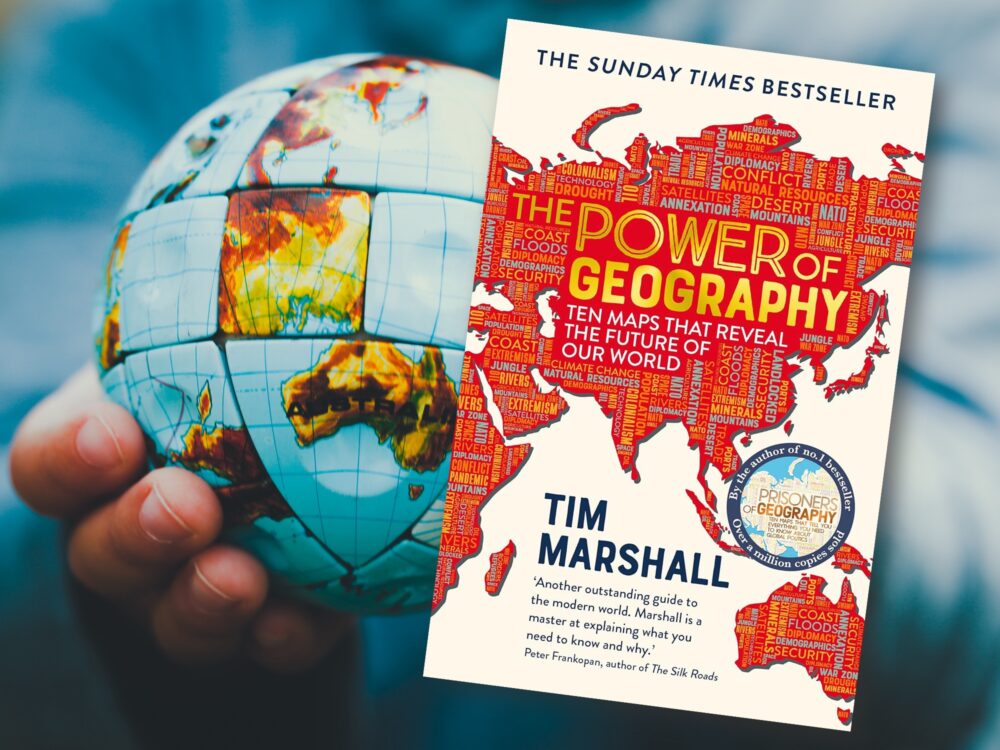
“The Power of Geography: Ten Maps That Reveal the Future of Our World” by Tim Marshall is a compelling exploration of how geography shapes the political and economic landscapes of ten key regions. Published in 2021, this book delves into the influence of geographical features such as mountains, rivers, and coastlines on the destinies of nations.
Marshall examines countries like Australia, Iran, Saudi Arabia, the UK, Greece, Turkey, the Sahel, Ethiopia, Spain, and even outer space, highlighting how their unique geographies impact their roles on the global stage.
Marshall’s analysis is both accessible and thought-provoking, offering insights into how historical and contemporary geopolitical issues are deeply intertwined with geographical factors. He argues that understanding these geographical influences is crucial for grasping the complexities of international relations and predicting future global dynamics. The book is a sequel to his previous bestseller, “Prisoners of Geography,” and continues to build on the idea that geography is a fundamental force in shaping the world.
Synopsis
“The Power of Geography” by Tim Marshall spans around 320 pages and comprises an introduction and ten insightful chapters, each delving into the geographical and geopolitical nuances of a specific region or theme.
- Introduction: In the introduction, Marshall explains the importance of geography in shaping global politics and the future of international relations. He outlines the central thesis of the book, emphasising how geographical features influence the destiny of nations and the balance of power.
- 1. Australia: This chapter explores Australia’s strategic importance due to its vast natural resources, geographical isolation, and its role in the Indo-Pacific region. Marshall discusses how Australia’s relationships with neighbouring countries and global powers like China and the United States impact its foreign policy and security strategies.
- 2. Iran: This chapter examines the country’s geographical position, which has historically made it a crossroads of empires. Marshall delves into Iran’s mountainous terrain, its significant oil reserves, and how its location influences its regional ambitions and geopolitical tensions, particularly in the Middle East.
- 3. Saudi Arabia: In this chapter, Marshall analyses Saudi Arabia’s geographical and geopolitical significance, rooted in its vast desert landscape and substantial oil reserves. He discusses the kingdom’s strategic role in the Gulf, its relationships with neighbouring countries, and the internal and external challenges it faces.
- 4. The United Kingdom: This chapter investigates the UK’s geographical features and their impact on its historical and contemporary global influence. Marshall explores the implications of the UK’s island geography, its colonial past, and its current position in global politics post-Brexit.
- 5. Greece: Here, Marshall looks at Greece’s strategic location at the crossroads of Europe, Asia, and Africa. He discusses how Greece’s geography has influenced its historical conflicts, its role in the EU, and contemporary issues like migration and economic stability.
- 6. Turkey: Marshall examines Turkey’s pivotal location straddling Europe and Asia, its control over key waterways like the Bosphorus, and its complex relationships with neighbouring countries. He highlights how Turkey’s geography has shaped its historical empire and its current strategic ambitions.
- 7. The Sahel: In this chapter, Marshall discusses the Sahel region in Africa, focusing on its geographical challenges like desertification, political instability, and its significance as a frontier between the Arab world and sub-Saharan Africa. He explores the implications for regional and global security.
- 8. Ethiopia: Marshall highlights Ethiopia’s unique position as a landlocked country in the Horn of Africa, with its rugged terrain and historical independence. He discusses Ethiopia’s role in regional politics, its internal ethnic diversity, and its ambitions for economic development and stability.
- 9. Spain: This chapter explores Spain’s geographical position on the Iberian Peninsula, its historical significance as a global maritime power, and its current geopolitical challenges within Europe. Marshall discusses Spain’s regional issues, including Catalonia’s independence movement and its role in the EU.
- 10. Space: In the final chapter, Marshall takes a futuristic look at the geopolitics of outer space. He explores how the geographical realities of space will shape international relations, the competition for space resources, and the strategic importance of space exploration for global powers.
Why you should read it?
For the general public, “The Power of Geography” is worth reading because it offers an accessible yet profound exploration of how geographical factors shape global politics and international relations. Tim Marshall’s engaging writing style makes complex geopolitical concepts easy to understand, providing readers with a clearer perspective on current events and global issues.
By breaking down the significance of geographical features such as mountains, rivers, and coastlines in shaping nations’ destinies, the book enriches readers’ understanding of the world.
It also encourages readers to think critically about how geography continues to influence political decisions and global power dynamics, making it both an informative and thought-provoking read.
For the specialised public, including scholars, policymakers, and students of international relations, the book provides valuable insights into the interplay between geography and geopolitics.
Marshall’s thorough analysis backed by historical context and contemporary examples, offers a nuanced understanding of how geographical factors drive political strategies and economic policies. The book serves as a useful resource for those looking to deepen their knowledge of geopolitical trends and the factors that underpin them.
Critics and review
Tim Marshall’s book, “The Power of Geography: Ten Maps That Reveal the Future of Our World”, has received a mix of praise and criticism.
Critics have noted that Marshall tends to emphasise the British perspective, which some readers find overly simplistic and not reflective of the complexities of global geopolitics. The Sahel region chapter, in particular, has been critiqued for its handling of French influence.
Despite these criticisms, the book has been lauded for making geopolitical issues accessible to a broad audience.
Marshall’s engaging writing style and insightful analysis have been highlighted as strengths, making it a valuable read for those interested in understanding the influence of geography on global politics.
On book platforms, “The Power of Geography” has garnered positive ratings. It holds a 4.5-star rating on Amazon based on over 5,000 reviews. Similarly, on Goodreads, the book has a rating of 4.2 stars from more than 20,000 ratings.
These ratings reflect the book’s popularity and the appreciation of readers for Marshall’s ability to elucidate complex geopolitical concepts in an engaging manner. Overall, while the book has faced some criticism, it remains a well-regarded work in the field of geopolitical literature.
Verdict
Tim Marshall’s “The Power of Geography” offers a compelling exploration of how geography shapes global politics and international relations, making complex geopolitical concepts accessible to a broad audience. While the book has faced some criticism for its perceived bias towards British perspectives and the handling of certain regions, its engaging writing style and insightful analysis have been widely praised.
By examining ten key regions, Marshall effectively illustrates the profound influence of geographical features on the destinies of nations, providing both general readers and specialists with valuable insights into the interplay between geography and geopolitics. Despite its flaws, the book remains a significant contribution to understanding the forces that shape our world.
About the author
Tim Marshall is a distinguished British journalist, author, and broadcaster, specialising in foreign affairs and international diplomacy. He began his career as a correspondent for LBC and later reported for the BBC and Sky News, where he served as the Diplomatic Editor and Foreign Affairs Editor.
Over his career, Marshall has reported from over thirty countries, including conflict zones such as Bosnia, Kosovo, Afghanistan, Iraq, and Syria. He has authored several best-selling books, including “Prisoners of Geography,” “The Power of Geography,” “Divided: Why We’re Living in an Age of Walls,” and “Shadowplay: The Inside Story of Europe’s Last War”.
Marshall is also the founder and editor of the news web platform The What and The Why, which provides a forum for non-partisan views on world news events.
While Marshall is widely respected for his insightful analysis and extensive reporting, he has faced some controversy over his views on geopolitical issues. Critics have accused him of having a biased perspective, particularly in his handling of certain regions and his perceived alignment with Western viewpoints.
Despite these criticisms, Marshall continues to be a prominent voice in international journalism and geopolitics.

Leave a Reply